








Industrial export industry insights are becoming harder to separate from broader supply-chain strategy. Reshoring, nearshoring, and regional manufacturing are no longer side conversations reserved for trade-policy teams. They now affect where engineers qualify components, how procurement evaluates risk, which distributors hold inventory, and whether a machine builder can keep a production line running when a single precision part is delayed.
For companies working with bearings, transmission assemblies, chains, seals, hydraulic valve blocks, machined components, and other motion-critical products, reshoring does not simply mean moving a factory closer to the end market. In many cases, it means redesigning the supplier network around shorter decision loops, clearer technical accountability, and a more realistic view of total landed cost.
That distinction matters. A component may be inexpensive at the purchase-order stage yet expensive in operation if its qualification cycle is slow, its metallurgy is unclear, its delivery dates are unstable, or a failure requires a long cross-border investigation. The industrial export market is therefore shifting from a narrow focus on unit price toward a broader question: which supply network can reliably support the product throughout its service life?
Reshoring Is a Supply-Chain Reconfiguration, Not a Return to Old Manufacturing Maps
There is a temptation to describe reshoring as a simple reversal of globalization. That reading is too blunt. Global production has built deep capabilities that cannot be replicated overnight, especially in special steels, precision grinding, casting, surface treatment, tooling, electronics, and high-volume subassembly. A plant may relocate final assembly while remaining dependent on imported raceways, alloy inputs, hydraulic cartridges, sensors, or precision fasteners.
What is changing is the location of control. Manufacturers increasingly want critical engineering decisions, supplier development, final configuration, and service inventory closer to the markets they serve. This often produces a layered model: globally sourced materials or specialized parts, regionally assembled modules, and locally supported aftermarket operations. It is less dramatic than a full factory relocation, but it can materially reduce disruption when transport routes, trade rules, or demand patterns change.
The strongest reshoring decisions tend to start with product architecture rather than political headlines. If a gearbox, actuator, conveyor system, or hydraulic power unit contains a handful of high-risk components, the company must ask where technical ownership should sit. Some parts can remain globally sourced without creating unacceptable exposure. Others require local or regional alternatives because they are difficult to substitute, slow to approve, or essential to safety and uptime.
This is why industrial export industry insights need to go deeper than country comparisons. The more useful analysis examines dependency at component level: material grade, tolerance stack, heat treatment route, sealing compatibility, fatigue life expectations, tooling lead time, and the availability of test capacity. A supplier map that ignores these details can look diversified on paper while still relying on one constrained process far upstream.
Why Precision Components Are Usually the Hard Part
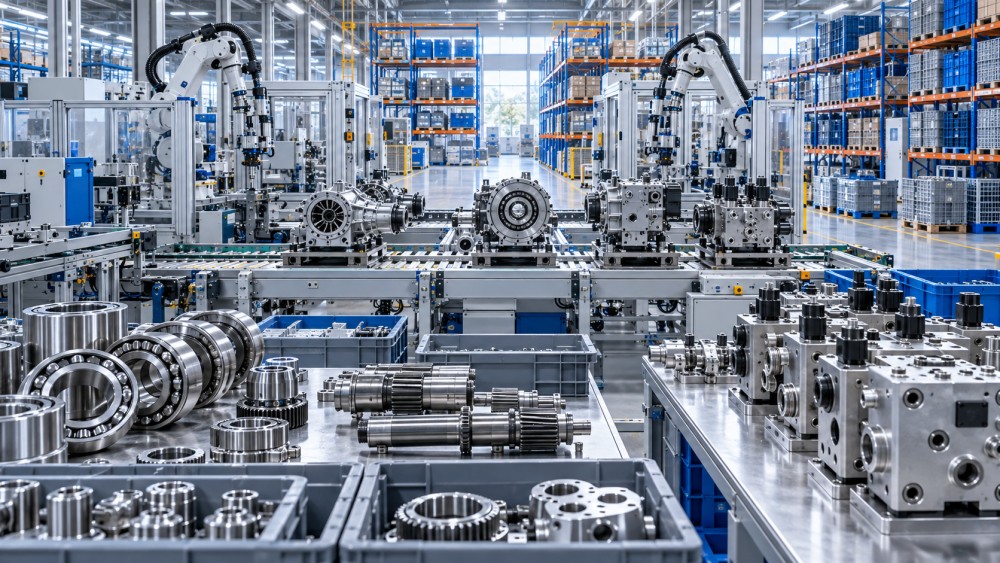
In industrial equipment, the part that causes the largest operational problem is not always the most expensive one. A small bearing, a specialized chain link, a spool-and-sleeve fit inside a hydraulic valve, or a seal exposed to aggressive fluid conditions can determine whether an entire machine meets its design life. These parts sit at the intersection of material science, process control, and real operating conditions.
Consider the practical difficulty of changing a supplier for a high-load bearing. The outside dimensions may match, but interchangeability is not guaranteed. Raceway geometry, internal clearance, cage material, lubrication assumptions, surface finish, and heat-treatment consistency all influence performance. In hydraulic systems, a replacement valve block may fit mechanically yet behave differently because of pressure-drop characteristics, contamination sensitivity, thermal expansion, or machining variation in internal passages.
That is why regional sourcing programs sometimes disappoint. Procurement may successfully shorten the shipping distance, but engineering discovers later that a “like-for-like” component requires extensive validation. The cost is not merely in testing. It can also appear as delayed machine release, more frequent maintenance, field-service complexity, or a larger safety-stock requirement to protect against quality variation.
A more disciplined approach separates components into three groups: readily substitutable items, technically qualified alternatives, and parts with no practical short-term replacement. This classification should be reviewed regularly because the bottleneck may shift. A component once considered routine can become strategic if a particular alloy, coating process, or precision machining capability becomes constrained.
The Trade-Off Is Not Local Versus Global
The commercial debate is often framed as a choice between low-cost offshore supply and high-cost domestic production. Real industrial decisions are more complicated. A regional source may offer faster engineering feedback and lower transit risk but lack scale in raw-material purchasing. An established export supplier may provide exceptional process maturity while requiring longer replenishment windows. Neither option is automatically superior.
The practical metric is total cost of continuity. It includes purchase price, freight, inventory, qualification effort, downtime exposure, warranty risk, and the time executives spend resolving supply interruptions. Not every category needs to be localized. But every critical category needs a defensible continuity plan.
Regionalization Changes the Role of Industrial Exporters
Reshoring does not eliminate industrial exports; it changes what buyers expect from exporters. Exporters that compete only on catalog breadth and quotation speed may find their position vulnerable. Buyers increasingly look for suppliers that can explain material substitutions, provide traceable revision control, hold regional stock, and support application-level discussions rather than simply ship parts.
For distributors, this shift is particularly significant. The distributor is no longer just a channel between factory and buyer. In a fragmented supply environment, it may become the party that consolidates demand, verifies alternatives, maintains local availability, and identifies which imported components are truly critical. That requires technical depth. A distributor that cannot distinguish a dimensional equivalent from a functional equivalent will struggle when customers ask for substitution advice under pressure.
Manufacturers should also be cautious about treating dual sourcing as a box-ticking exercise. Two suppliers located in different countries may still rely on the same steel mill, forging source, coating chemistry, or semiconductor channel. Geographic diversity is useful, but process diversity is often more meaningful. In some applications, the best hedge is not a second supplier but a design revision that accepts a broader range of qualified components without sacrificing performance.
Information Quality Becomes a Competitive Variable
As supply chains become more regional and more technically segmented, decision-makers need information that connects markets to engineering realities. It is not enough to know that special-steel pricing is volatile or that trade conditions may change. The real question is how those shifts affect a specified shaft, bearing ring, chain pin, valve body, or actuator assembly.
This is the value of specialized intelligence platforms such as the Global Precision Components & Motion Matrix (GPCM). The useful role of a sector intelligence center is not to produce more headlines. It is to translate developments in materials, tribology, fluid dynamics, industrial economics, and trade conditions into better sourcing judgments. For example, the evolution of composite bearings, maintenance-free chains, or integrated high-pressure valve blocks has implications for maintenance planning, supplier qualification, and export-market positioning that are easy to miss when each department works from separate data.
For precision manufacturing businesses, the most valuable intelligence is often unglamorous: a clearer view of where a tolerance requirement creates supplier concentration; an early signal that a material substitution may require revalidation; or evidence that a regional service model is becoming more important than another low-cost production location. These are the details that prevent reactive decisions later.
What a Credible Reshoring Review Should Include
A credible review should begin with the bill of materials, not with a map. Identify components that can stop production, those with long qualification cycles, and those subject to narrow manufacturing capability. Then examine the suppliers behind the immediate supplier. If the chain depends on a single finishing process, specialized raw material, or hard-to-replace tooling set, that dependency should be visible to management.
It is also wise to involve engineering, quality, procurement, operations, and aftermarket teams from the beginning. Each sees a different failure mode. Procurement sees commercial concentration. Engineering sees design constraints. Quality sees validation burden. Operations sees line stoppage. Aftermarket sees the long tail of legacy equipment. Reshoring plans fail when one of these views is treated as secondary.
Before approving a relocation or new regional source, companies should test a few practical questions: Can the supplier reproduce the required process, not just the drawing? Is there enough inspection and test capability to manage ramp-up? How will engineering changes be controlled across regions? What happens when demand drops below the volume that justified the new footprint? These questions are less exciting than an announcement of local production, but they expose whether the plan can survive normal industrial volatility.
The Next Phase Will Reward Selective, Technically Informed Localization
The likely direction is not a world of fully domestic supply chains. It is a world where companies are more deliberate about which capabilities must be nearby, which inputs can remain global, and where redundancy genuinely improves resilience. Precision components will remain central to that calculation because they carry disproportionate technical and operational risk relative to their physical size.
For industrial exporters, manufacturers, and distributors, the immediate task is to replace broad assumptions with component-level evidence. A shorter supply route is useful. A lower unit cost is useful. Neither is sufficient if the network cannot support the required tolerance, performance, traceability, and service response. The firms that navigate reshoring well will be those that treat supply-chain geography as an engineering and commercial design choice, not merely a procurement trend.
Related News
- How to control design changes when working with an OEM supplierOct 18, 2026Working with an OEM cooperation supplier? Learn how to control design changes, align approvals, verify revisions, and prevent costly production errors with a practical change-control workflow.
- How to vet North American fluid dynamics engineering firms for CFDOct 13, 2026Searching for fluid dynamics engineering North America? Discover how to vet CFD firms, assess validation, and choose a partner for confident design decisions.
- How to limit obsolete stock in industrial component distributionOct 19, 2026Optimize industrial components for distribution with SKU-level replenishment and verified replacements. Learn how to reduce obsolete stock while protecting essential spares and equipment uptime.
- Which sub-assembly tasks can industrial equipment suppliers handle?Oct 16, 2026What are common sub-assembly capabilities for industrial equipment suppliers? Explore mechanical, hydraulic, and electromechanical modules—and key checks to choose the right supplier.
Related News
- 00
0000-00
Can fluid power systems for robotics deliver precise motion control? - 00
0000-00
How to control design changes when working with an OEM supplier - 00
0000-00
When do precision ground gears reduce noise in high-speed gearboxes? - 00
0000-00
How pressure ratings affect the price of flow control components - 00
0000-00
How to choose gear materials for high-load industrial gearboxes
Dr. Alistair Vaughn
Strategic Intelligence Center