








Limit obsolete stock by controlling replenishment at the SKU level, linking demand to equipment still in service, and confirming technical suitability before treating one component as a replacement for another. Broad inventory cuts leave essential spares unavailable while slow-moving variants continue accumulating. A better approach separates stock that protects equipment uptime from stock whose future application is disappearing.
For industrial components for distribution, sales history alone is an incomplete guide. A bearing might sell infrequently because it supports a long maintenance interval. A hydraulic valve might show recent sales even though the machine configuration using it has been discontinued. Inventory decisions need both commercial evidence and a clear picture of where each part can still be installed.
Separate slow movement from genuine obsolescence
Start by distinguishing three conditions: low demand, loss of application, and deterioration in storage. Each requires a different response. Slow-moving stock needs a review of demand timing and service commitments. A part with no remaining approved application needs an exit route. Stock with damaged packaging, corrosion, or expired storage limits needs a condition assessment before it returns to available inventory.
Age should trigger investigation, not automatically determine disposal. A long-held coupling element could remain necessary for an active machine population, while a recently purchased electronic valve controller could already be stranded by a design revision. Record the reason for concern alongside the age of the stock.
For each vulnerable SKU, establish the last genuine customer requirement, known equipment applications, approved successors, outstanding commitments, and storage restrictions. Separate external consumption from branch transfers and internal adjustments. Moving a box between warehouses does not demonstrate demand.
Also distinguish an inactive application from an unrecorded one. Missing machine references in the item record create uncertainty; they do not prove that the component has no use. Resolve that uncertainty before approving another order or writing off the remaining balance.
Give different stock different replenishment rules
A single inventory target is poorly suited to a range containing standard bearings, application-specific chain attachments, and configured hydraulic assemblies. Segment stock using demand regularity, application breadth, replacement difficulty, and the consequence of unavailability. Sales value helps set review priorities, but it cannot establish technical necessity.
Apply these rules below the product-family level. Two bearings with the same boundary dimensions can have different demand prospects because their clearance, sealing, or cage specifications serve different operating conditions. Combining them into one planning category hides the variant most likely to become obsolete.
Keep the reason for protected stock visible. “Critical spare” is insufficient without an application, required response time, and review date. Otherwise, a temporary exception becomes permanent inventory long after the supporting equipment has left service.
Forecast the event that consumes the part
Industrial spare-parts demand often arrives in bursts. Routine maintenance, shutdowns, machine rebuilds, and emergency failures produce different patterns. A simple average across all issues can turn a one-time overhaul into an ongoing replenishment signal.
Tag demand by its source wherever records allow. Separate recurring consumption from project orders, warranty replacements, and exceptional repairs. Keep unusual orders in the history, but prevent them from automatically increasing the forecast for ordinary replenishment.
For intermittent items, examine both the quantity used per event and the interval between events. Monthly averages alone conceal long periods without demand. Where machine counts and maintenance plans are available, connect expected consumption to the equipment population rather than extrapolating isolated invoices.
Recorded sales also miss requirements that could not be supplied. Capture credible lost demand with the requested specification and application. A request abandoned because of price or an unsuitable alternative should not carry the same planning weight as a confirmed requirement lost through a stockout.
Use an inventory position that includes usable stock and confirmed incoming quantities, less firm allocations and backorders. Compare that position with expected demand over the applicable replenishment period and the chosen service buffer. Quarantined goods and unapproved substitutes should remain outside usable availability.
Review forecasts when their underlying assumptions change. A shortened lead time reduces the need for coverage; retirement of an equipment line removes demand. Longer lead times justify additional stock only where future consumption or a service obligation supports the exposure.
Technical compatibility determines whether stock has another use
Cross-referencing can unlock existing stock, but an apparent dimensional match does not establish interchangeability. Consolidating SKUs without engineering approval risks creating unavailable stock in the system and unsuitable parts at the installation point.
For bearings, compare bore, outside diameter, and width alongside internal clearance, tolerance class, seals, lubrication, cage construction, and relevant load and speed requirements. Temperature and shaft or housing fits affect operating clearance. A component that physically fits can still perform differently under the intended conditions.
Power transmission parts require equally careful matching. Chain pitch alone does not confirm compatibility: roller dimensions, strand count, attachments, strength characteristics, and lubrication arrangements affect suitability. Couplings require attention to torque, speed, bore and keyway geometry, misalignment capacity, and elastomer compatibility with temperature and exposure.
For fluid control components, include port and mounting details, pressure rating, flow characteristics, seal material, fluid compatibility, leakage behavior, and actuation requirements. A valve with matching connections and pressure capacity can still alter machine behavior through a different spool function or electrical configuration.
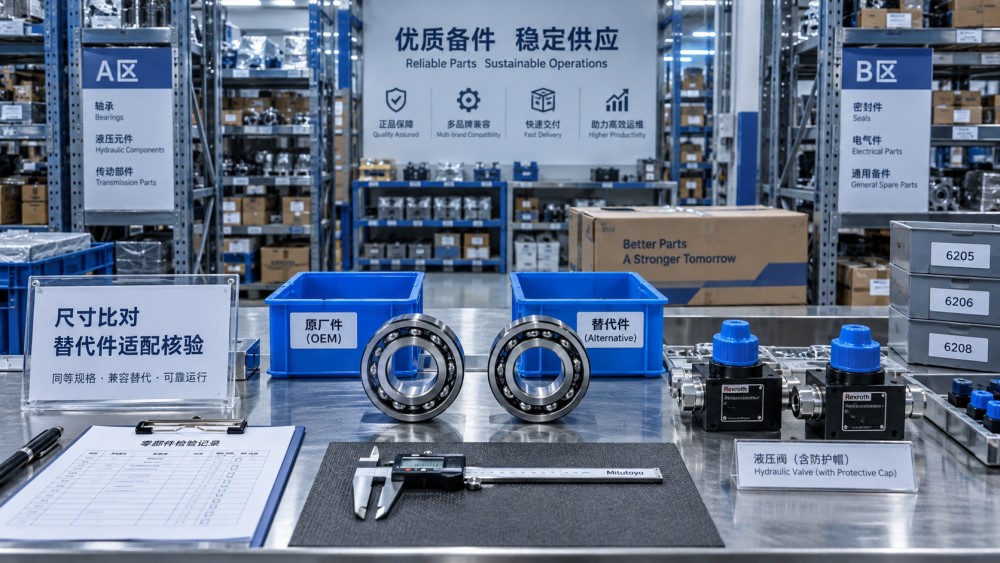
Maintain an approved substitution record stating the original item, replacement, applicable equipment, operating limits, and required installation changes. Distinguish direct replacements from alternatives requiring modification. Keep the approval source and revision date with the record so that purchasing and stock allocation use the same technical basis.
Where approval remains unresolved, treat the alternative as separate stock. That prevents a planning system from using an unverified cross-reference to suppress a necessary purchase or justify acquiring excess quantities of a superficially similar part.
Put limits around minimum orders and lifecycle changes
Minimum order quantities create obsolete stock when the surplus has no credible consumption route. Before accepting a purchasing multiple, compare the resulting balance with expected use, storage life, and the application’s remaining service period. A lower unit price offers little benefit if the additional units remain unsold.
Negotiate the mechanism that addresses the actual constraint. Scheduled releases suit recurring requirements; smaller packs reduce excess from packaging multiples. Stock rotation addresses changing assortment needs, while consignment changes ownership timing. Consignment still needs removal terms for obsolete material, since warehouse space and handling remain occupied.
Make return provisions specific enough to use. Define eligible item codes, packaging condition, traceability requirements, notification deadlines, restocking charges, and responsibility for freight. Clarify whether configured assemblies, discontinued products, and opened packs are excluded. General promises about returns provide little protection when the surplus consists of exactly those items.
Discontinuation notices need a different response from ordinary replenishment. Estimate remaining requirements from active equipment, expected maintenance events, existing stock, and approved alternatives. Include firm incoming orders before considering a final purchase. A last-time buy based only on historic annual sales can preserve demand from machines that no longer operate.
Supplier acknowledgments also deserve review when they substitute revised part numbers or change delivery quantities. Accepting a successor into the purchasing system before its application is approved can create stock that appears current but cannot satisfy the original requirement.
Prevent usable stock from becoming unsaleable in storage
Physical condition and traceability determine whether inventory remains usable. Preserve identification, batch information, protective packaging, and relevant inspection records. A technically correct component without reliable identification can become difficult to allocate or approve, especially when visually similar variants share a bin.
Use storage controls appropriate to the item. Bearings need protection against contamination and corrosion; elastomer seals and coupling inserts require conditions consistent with their material and documented storage guidance. Hydraulic components need protected ports and cleanliness controls. Follow item-specific limits instead of applying a blanket shelf-life assumption across the range.
Where a defined expiry applies, issue eligible stock in expiry order. For other items, use receipt age and condition to guide rotation. Assess opened packaging before returning stock to saleable status. Repacking cannot restore lost preservation or establish cleanliness that has not been verified.
Make the exception review lead to an action
An aging report becomes useful when it connects each item to a decision. Prioritize stock with no recent genuine demand, shrinking application coverage, unresolved successor mappings, or incoming quantities that exceed a revised requirement. Review non-cancellable purchase orders alongside stock already received; future receipts can enlarge an exposure that is otherwise being reduced.
Assign a disposition and a date to each material exception:
- Retain a defined reserve where active equipment and a service commitment support the quantity. Record what would trigger a reduction.
- Routine replenishment stops when the remaining balance already covers credible demand. Reduce or cancel open orders where contract terms permit.
- Reallocate approved stock to a location with a documented requirement, accounting for transfer cost and avoiding duplicate purchasing at the receiving location.
- Return, sell through a suitable secondary channel, or recycle material with no supported application. Preserve accurate condition and specification descriptions; discounting does not make an unsuitable component interchangeable.
Measure whether these decisions reduce recurrence. Track obsolete-stock exposure separately from ordinary aging, and include open-order commitments. Compare the result with availability for protected spares and fulfillment of genuine demand. Lower stock value accompanied by more failures to supply essential parts signals that the replenishment rules need adjustment.
The most useful review ends with a change to the source of the excess: a purchasing multiple, an obsolete forecast, an unsupported reserve, or an incomplete substitution record. Correcting that cause prevents the next receipt from recreating the same problem after the current stock has been cleared.
Related News
- How to control design changes when working with an OEM supplierOct 18, 2026Working with an OEM cooperation supplier? Learn how to control design changes, align approvals, verify revisions, and prevent costly production errors with a practical change-control workflow.
- How to vet North American fluid dynamics engineering firms for CFDOct 13, 2026Searching for fluid dynamics engineering North America? Discover how to vet CFD firms, assess validation, and choose a partner for confident design decisions.
- How to limit obsolete stock in industrial component distributionOct 19, 2026Optimize industrial components for distribution with SKU-level replenishment and verified replacements. Learn how to reduce obsolete stock while protecting essential spares and equipment uptime.
- Which sub-assembly tasks can industrial equipment suppliers handle?Oct 16, 2026What are common sub-assembly capabilities for industrial equipment suppliers? Explore mechanical, hydraulic, and electromechanical modules—and key checks to choose the right supplier.
Related News
- 00
0000-00
Can fluid power systems for robotics deliver precise motion control? - 00
0000-00
How to control design changes when working with an OEM supplier - 00
0000-00
When do precision ground gears reduce noise in high-speed gearboxes? - 00
0000-00
How pressure ratings affect the price of flow control components - 00
0000-00
How to choose gear materials for high-load industrial gearboxes
Dr. Alistair Vaughn
Strategic Intelligence Center