








Before you size a motion system, a careful product family comparison for servo motors can save hours of rework later. On paper, many servo families look similar: same power range, same flange sizes, same general control intent. In practice, the differences that matter most are often buried in the details—continuous torque behavior, rotor inertia, thermal design, encoder type, overload profile, and how well the motor speaks to the drive and control stack around it.
For technical evaluators, that’s the real challenge. The “best” servo motor is rarely the one with the highest peak torque or the newest brochure language. It is the one whose product family fits the duty cycle, mechanical load, feedback needs, and integration constraints of the machine. Compare the wrong families too late, and you end up with oversizing, unstable tuning, excessive heat, or a system that meets speed targets but misses accuracy and life expectations.
Start with the duty profile, not the nameplate
A useful comparison begins with how the motor will actually work. Two servo families can share the same rated power and still behave very differently once the load starts cycling. For sizing, look at continuous torque, peak torque duration, acceleration demand, and rest periods. A family built for short bursts may look strong in a catalog, but if your application runs at moderate torque for long periods, thermal saturation becomes the hidden bottleneck.
That is why thermal performance deserves more attention than many teams give it. Some product families dissipate heat more effectively through a larger frame, better winding design, or optional forced cooling. Others rely on compact packaging that works well in intermittent motion but becomes limiting under sustained load. If your process includes frequent starts, stops, and dwell times, compare the temperature rise characteristics across families rather than assuming equivalence from power ratings alone.
Torque, inertia, and the shape of the load
Once the duty cycle is clear, compare how each servo family handles inertia matching. The ratio between motor inertia and reflected load inertia affects controllability, tuning margin, and settling behavior. A family with a low-rotor-inertia design may deliver crisp response for light, fast axes, while a heavier rotor can be more forgiving in some high-load systems. Neither is universally better.
Technical evaluators often focus on peak torque and forget that the load shape matters just as much. Linear axes, rotary tables, indexing systems, and vertical lifts impose different inertia profiles. If the family comparison stops at rated torque, you may miss whether the motor can hold position cleanly, recover from load disturbances, or accelerate without pushing the drive into aggressive tuning settings.
In motion systems, a motor that “works” and a motor that “works well” are often separated by inertia compatibility.
Feedback resolution is not just a precision checkbox
Encoder and feedback options can change the whole character of a servo family. Incremental feedback, absolute encoders, multi-turn memory, and high-resolution optical or magnetic sensing all support different levels of control fidelity. The comparison should ask more than “What is the resolution?” It should ask how that feedback behaves in the real control loop.
For example, higher resolution can improve low-speed smoothness and positioning confidence, but only if the drive and controller can use that signal effectively. In some cases, the practical benefit is limited by noise, mechanical compliance, or the speed of the network. In others, the feedback choice affects commissioning time, homing strategy, and restart behavior after power loss. If the machine needs frequent position recovery, the feedback architecture becomes a system-level decision rather than a motor feature.
Mounting, dimensions, and the cost of “almost compatible”
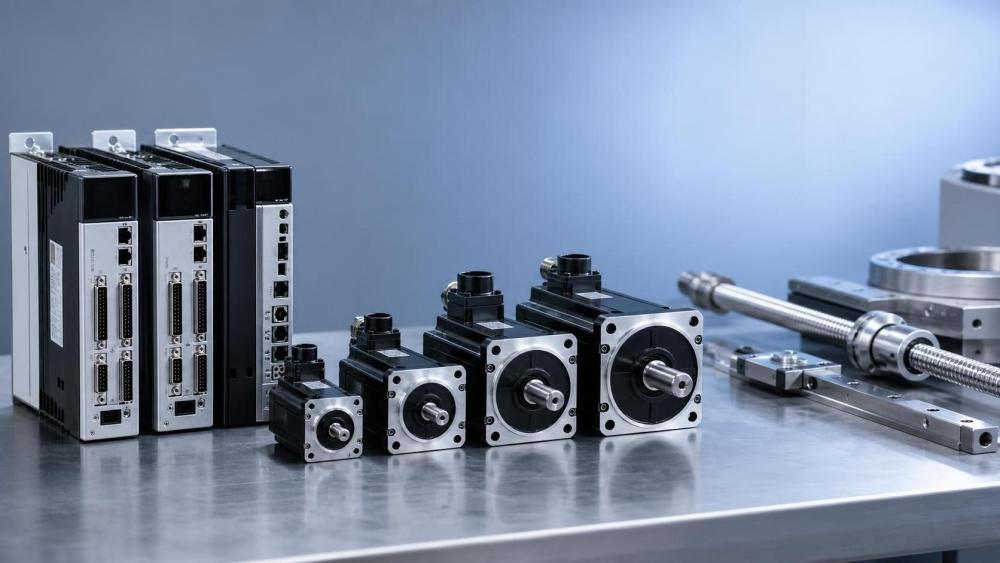
Physical compatibility is easy to underestimate. Product families may share nominal frame sizes but differ in shaft type, flange pattern, connector orientation, cable routing, and brake integration. These details can be the difference between a clean retrofit and a redesign that eats budget and time. When comparing servo motor families, check whether the mechanical interface aligns with existing gearboxes, couplings, and machine clearances.
For OEMs and equipment builders, connector placement can matter as much as torque curves. Side exits, rear exits, and rotatable connectors change cabinet layout, bend radius, and service access. If the application sits inside a dense machine frame, cable management and connector access should be part of the selection process from day one.
Drive compatibility and control behavior
A servo motor never really works alone. The family comparison should include how the motor pairs with drives, fieldbus protocols, autotuning features, and safety functions. Some families are optimized for a tightly integrated vendor ecosystem, while others are more flexible across controllers and third-party drives. The wrong assumption here can produce commissioning friction even when the motor itself is technically suitable.
Look closely at control response at low speed, stall behavior, and how the drive handles overload events. Does the family support the control modes your machine needs? Can it accept the feedback type without adapters or compromises? Are parameter sets easy to migrate across frame sizes within the same family? These questions matter because many projects scale from one axis to another, and consistency across the family can reduce engineering effort later.
Environmental limits and service life are part of sizing
Servo selection is often treated as a performance exercise, but environmental exposure changes the real answer. Compare sealing level, bearing design, allowable ambient temperature, vibration tolerance, and any special requirements for dust, moisture, or washdown conditions. A family that looks ideal in a clean lab environment may need derating or additional protection in a production cell.
Service life is also tied to mechanical stress that does not show up in a simple torque calculation. Frequent direction changes, shock loads, belt tension, and misalignment can shorten bearing life. If the motion axis is expected to run for long hours, the family comparison should include maintenance expectations, grease life assumptions, and how easily the motor can be inspected or replaced without disturbing the rest of the machine.
Total cost of ownership is where comparisons get honest
It is tempting to compare only motor price, especially during early sourcing. But product family comparison for servo motors becomes more meaningful when you include the broader cost picture. A slightly higher-cost family may reduce tuning time, lower cabinet complexity, or improve yield through better positioning consistency. Another may be cheaper upfront but harder to integrate, with higher engineering hours and longer commissioning cycles.
This is where technical evaluators and purchasing teams need a shared language. Cost is not only the unit price; it is also downtime risk, spare parts strategy, training burden, and how many variants the plant must support. A family with strong platform consistency can simplify inventory and field service, which often matters more than a small difference in catalog price.
A practical comparison checklist for shortlisting
When you are narrowing options, compare these family-level points side by side:
- Continuous torque, peak torque, and thermal behavior under the actual duty cycle
- Rotor inertia and how it matches the reflected load
- Encoder type, resolution, and restart or homing requirements
- Frame size, shaft, flange, connector, and brake compatibility
- Drive interface, tuning support, and network compatibility
- Environmental protection, vibration tolerance, and bearing life expectations
- Platform consistency across multiple axis sizes and spare-part planning
Used well, this kind of comparison does more than narrow a parts list. It reveals whether a servo family is a platform you can build on, or just a single motor that happens to fit a first-pass calculation.
What experienced evaluators look for last
After the technical numbers are aligned, the final check is often about stability over time. Can the family scale to related machines without forcing a new control philosophy? Is documentation clear enough for maintenance teams? Are variants available when supply chains tighten? In industrial motion, a good selection is one that remains sensible after the first machine is built, not only during the original sizing exercise.
That is why the best servo motor decisions rarely come from comparing isolated specifications. They come from comparing families as systems: how they behave, how they integrate, and how they support the machine across its full operating life. If you take that broader view early, sizing becomes less of a gamble and more of a controlled engineering choice.
Related News
- Component material comparison for wear resistance in moving partsSep 11, 2026Component material comparison for wear resistance: explore steel, bronze, polymers, ceramics, and composites to select reliable moving parts for real operating conditions.
- Can maintenance-free chains reduce maintenance costs in Southeast Asia?Sep 04, 2026Maintenance-free chains Southeast Asia can cut labor, lubricant, downtime, and replacement costs. Explore total cost benefits, technical limits, and smart selection strategies for regional industrial operations.
- How backlash affects precision powertrain components for automationAug 27, 2026Precision powertrain components for automation: learn how backlash affects accuracy, stiffness, wear, and long-term motion stability for smarter system selection.
- When do low backlash power transmission components matter mostAug 25, 2026Low backlash power transmission components matter most in servo, robotics, and precision automation. Learn when they improve accuracy, stability, and lifecycle performance.
Related News
- 00
0000-00
Where industrial intelligence delivers the most value in semiconductor fabs - 00
0000-00
How to size high pressure industrial valves for pressure spikes - 00
0000-00
How application engineering for fluid control reduces valve sizing risk - 00
0000-00
How to assess a semiconductor compliance platform for audit readiness - 00
0000-00
How to size fluid control components for pressure drop limits
Power Trans Designer
Strategic Intelligence Center