








Lubricant selection determines whether a bearing develops a stable protective film or operates with damaging metal-to-metal contact. A bearing can have the correct load rating, precision class, and installation method yet still fail early when its lubricant has the wrong viscosity, loses consistency at temperature, contains unsuitable additives, or cannot remain clean in service.
The lubricant must form a separating layer between rolling elements, raceways, cages, and contact surfaces while carrying heat away from the contact zone. It also has to remain in place, resist oxidation, exclude moisture and particles, and behave predictably as speed, load, temperature, and vibration change. These requirements often conflict. A lubricant that is sufficiently viscous for a heavily loaded slow shaft may create unacceptable churning losses in a high-speed spindle. A grease that resists washout may be too stiff to replenish a small, rapidly rotating bearing. Bearing life therefore depends on matching lubricant behavior to the actual operating condition rather than choosing a product solely by general-purpose labeling.
The lubricating film controls surface fatigue
Rolling bearings are designed around repeated concentrated contacts. Although rolling motion reduces sliding compared with a plain bearing, each rolling element still creates a highly stressed contact zone as it passes over the raceway. Under favorable conditions, an elastohydrodynamic lubricant film separates the microscopic surface peaks of the rolling element and raceway. The film reduces adhesive wear, limits frictional heating, and prevents direct welding and tearing of surface asperities.
When the film is too thin, the bearing enters mixed or boundary lubrication. Surface roughness begins to carry part of the load. This can produce polishing, smearing, micropitting, discoloration, or accelerated fatigue damage. These symptoms do not always appear immediately. A bearing may run quietly after installation and then degrade as its surfaces become rougher, the lubricant oxidizes, or contamination interrupts film formation.
Viscosity is the starting point because it strongly influences film thickness. Higher viscosity generally produces a thicker film at the same speed and temperature, but only within a useful range. Excessive viscosity raises fluid friction, increases operating temperature, and can restrict grease flow through narrow paths. The resulting heat lowers oil viscosity, so a lubricant selected to provide a generous film may eventually lose the advantage that prompted its selection.
Viscosity must be assessed at operating temperature
Catalog viscosity values are commonly stated at a reference temperature. Bearings do not operate at a reference temperature. Friction, ambient air, housing design, nearby process heat, cooling flow, and load all influence the temperature at the raceway. The relevant question is whether the base oil has enough viscosity where the bearing actually runs, not whether the oil appears heavy or light at room temperature.
A gearbox bearing and an electric-motor bearing may both use rolling elements, yet their lubrication requirements can differ sharply. A slow, heavily loaded gearbox shaft needs an oil film that survives high contact stress. A motor bearing running at high speed needs controlled drag and reliable grease distribution. At very high speed, too much oil or an overly viscous grease can churn, aerate, and heat the bearing. At very low speed or during oscillation, speed may be insufficient to generate a full fluid film, making base-oil viscosity and anti-wear or extreme-pressure chemistry more important.
Speed also changes how lubricant reaches the contacts. In an oil bath, a rotating element can pick up and distribute oil effectively until speed becomes high enough to create churning and foaming. In a grease-filled housing, the rolling elements work a channel through the grease. Much of the grease moves away from the active path, while a small amount of released base oil lubricates the contact. Filling the housing completely with grease does not create a larger safety margin; it frequently increases heat and can shorten grease life.
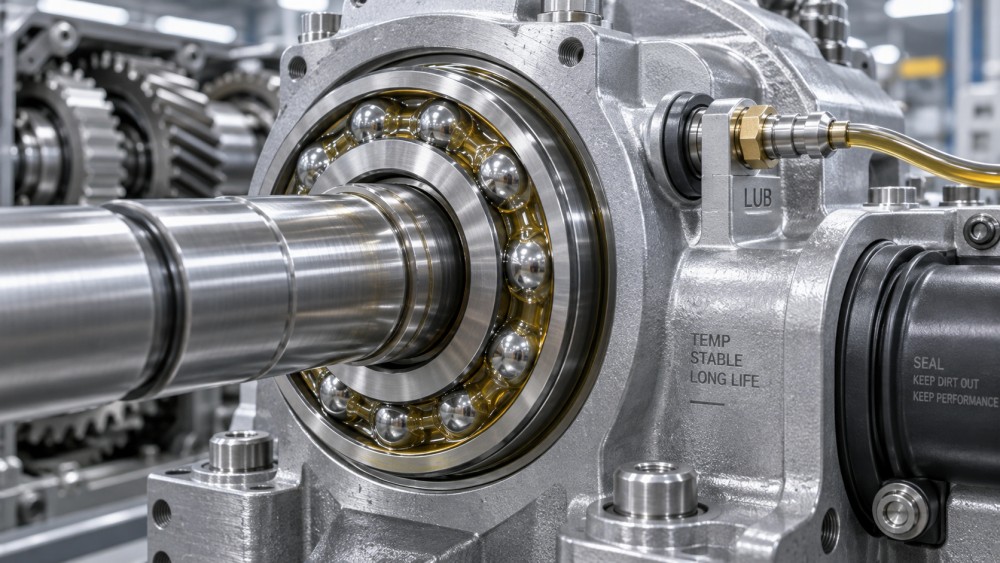
Grease selection involves more than NLGI consistency
Grease is a system composed of base oil, thickener, and additives. Its consistency describes how firm the finished grease is, but consistency alone does not reveal the viscosity of the oil that forms the lubricating film. Two greases with similar consistency can contain base oils with very different viscosity grades and can behave differently under the same bearing load.
The thickener affects mechanical stability, temperature capability, water resistance, and compatibility with other greases. Mixing greases with incompatible thickener systems can soften or harden the mixture, separate oil from the structure, reduce water resistance, or change the ability of the grease to stay in a bearing. A changeover should therefore not be treated as a simple top-up. Where practical, old grease should be removed from housings, lines, and cavities before the replacement grease is introduced. Residual material in dead zones can continue to influence the new lubricant long after the first relubrication.
Grease performance also changes after mechanical working. A grease pumped through a long line, forced through a small fitting, or sheared repeatedly in a high-speed bearing may not retain its original structure. Some applications require stable grease that will not soften and leak; others require enough oil release to replenish contacts during long intervals. Those are distinct properties. A grease that remains perfectly stiff but releases too little oil can leave a contact under-lubricated.
Additives solve specific problems and can create new ones
Additives are selected to address conditions that base oil alone cannot manage well. Antioxidants slow lubricant breakdown at elevated temperature. Rust inhibitors protect steel surfaces when humidity or condensation enters the housing. Anti-wear and extreme-pressure additives support contacts operating with marginal film thickness. Solid lubricants can be useful in certain slow-moving, highly loaded, or oscillating arrangements.
These chemistries should be tied to the bearing design and surrounding materials. Aggressive extreme-pressure additives are not automatically beneficial in every rolling bearing. At elevated temperature or in the presence of moisture, some additive families can be unsuitable for particular cage materials, coatings, or nonferrous components. Solid particles that perform well in slow, boundary-lubricated contacts may increase friction or interfere with smooth running in a precision, high-speed bearing.
Base-oil type matters for the same reason. Mineral, synthetic hydrocarbon, ester, silicone, and other base stocks differ in temperature response, oxidation resistance, seal interaction, and solvency. A lubricant that works well in a hot environment may affect elastomer seals differently from the existing lubricant. Selection must account for the complete bearing system: rings, rolling elements, cage, seals, housing, lubricant delivery method, and contamination exposure.
Contamination changes the required lubricant strategy
Particles, water, process fluids, and degraded lubricant can damage a bearing even when viscosity is otherwise appropriate. Hard particles entering the rolling contact create dents in raceways and rolling elements. As the bearing continues to run, stress concentrates around those dents and can initiate surface fatigue. Soft debris is also harmful because it can block grease passages, form abrasive sludge with dust, or interfere with the formation of a consistent film.
Water creates a different failure path. It promotes corrosion, weakens some grease structures, reduces film quality, and can react with additives. A bearing exposed to washdown, condensation, or humid outdoor cycles needs more than a nominally water-resistant grease. Seal design, housing orientation, vent location, relubrication practice, and storage conditions determine whether the lubricant remains protected before it reaches the bearing.
Relubrication can shorten life when quantity and interval are wrong
A correct grease can still fail as a maintenance practice. Too little grease allows oil starvation and poor contamination purging. Too much grease creates internal agitation, temperature rise, and leakage through seals. Leakage is often interpreted as proof that a seal has failed, although it may begin because the cavity was overfilled or because thermal expansion had no available relief path.
Relubrication intervals cannot be set from calendar time alone. Bearing size, speed, load, temperature, orientation, grease type, contamination level, and the effectiveness of seals all alter the rate at which useful lubricant is consumed or displaced. A clean, lightly loaded bearing may need little replenishment for a long period. A bearing near heat, moisture, vibration, or airborne dust may require a different interval primarily to purge contamination rather than to replace exhausted oil.
The delivery route deserves equal attention. A remote grease line can make servicing easier while hiding a blocked fitting, collapsed hose, or misdirected outlet. If grease is injected into the housing but cannot reach the bearing, the apparent maintenance record and the bearing condition will diverge. During installation or inspection, confirming purge paths and verifying that lubricant reaches the intended cavity prevents this error from becoming a recurring failure mode.
Lubricant faults can resemble mechanical faults
Noise, heat, vibration, and early fatigue are not uniquely caused by poor lubricant selection. Misalignment, excessive preload, loose fits, shaft deflection, electrical discharge, poor balance, damaged seals, and incorrect mounting can create similar symptoms. Conversely, an unsuitable lubricant can amplify the effect of a mechanical defect by reducing film thickness or trapping heat.
Diagnosis should begin with the operating history. A change that occurred immediately after a lubricant switch, relubrication, seasonal temperature shift, or washdown event deserves close attention. Gradual deterioration accompanied by increasing temperature and hardened deposits suggests oxidation or insufficient replenishment. Localized damage on one side of a raceway points toward loading or alignment as well as lubrication. The failure pattern should guide the investigation rather than serve as a reason to replace the bearing and refill the housing with the same material.
A practical basis for selection
Useful lubricant selection begins by defining the bearing type, size, rotational speed, load direction and magnitude, expected temperature range, and lubrication method. Those inputs establish the viscosity needed for film formation and whether grease, circulating oil, oil mist, air-oil, or another method can deliver lubricant without excessive heat. The next layer includes water exposure, dust, chemicals, seal material, cage material, relubrication access, and the consequence of leakage.
- For a heavily loaded bearing running slowly, prioritize film strength at the expected operating temperature and assess whether boundary-lubrication additives are compatible with the bearing materials.
- A high-speed arrangement requires attention to churning loss, grease channeling, oil-air separation, and the ability of the lubricant to release heat.
- Where washdown or condensation is present, combine a suitable corrosion-resistant lubricant with seal and drainage arrangements that prevent repeated water entry.
- For intermittent or oscillating motion, do not assume that a lubricant chosen for continuous rotation will develop an adequate hydrodynamic film.
The correct choice remains valid only while the lubricant is clean, at the required quantity, and able to reach the contact surfaces. Bearing life is therefore shaped by the combined effect of formulation, delivery, operating temperature, contamination control, and maintenance discipline. Treating lubrication as a bearing-system decision produces a more reliable result than treating grease or oil as a consumable chosen after the mechanical design is complete.
Related News
- How to choose gear materials for high-load industrial gearboxesOct 15, 2026Choose gear materials for high-load industrial gearboxes with confidence. Compare steel grades, heat treatments, and quality checks to reduce failures and improve service life.
- How to choose engineering plastics for gears without lubricationOct 14, 2026Choose engineering plastics for gears without lubrication. Compare POM, PA and PEEK, assess wear and heat, and discover how to validate reliable dry-running performance.
- Why Is Lubricant Selection Critical to Bearing Life?Oct 16, 2026Why is lubricant selection critical for bearing life? Discover how viscosity, grease, additives, contamination control, and relubrication affect reliability and prevent costly failures.
- What Supplier Data Proves Long-Term Bearing Availability?Oct 13, 2026What supplier data proves long-term bearing availability? Discover the lifecycle, material, quality, capacity, and delivery records that reduce supply risk.
Related News
- 00
0000-00
How to choose gear materials for high-load industrial gearboxes - 00
0000-00
How to choose engineering plastics for gears without lubrication - 00
0000-00
How to vet North American fluid dynamics engineering firms for CFD - 00
0000-00
How to qualify a semiconductor equipment parts supplier for traceability - 00
0000-00
Which sub-assembly tasks can industrial equipment suppliers handle?
Tribology Specialist
Strategic Intelligence Center