








Current inventory is weak evidence of long-term bearing availability. It shows what can ship now, not whether the same bearing—or a technically controlled replacement—will remain obtainable through an equipment’s service life. For machines with long maintenance cycles, certified spare-parts obligations, or costly shutdown exposure, the relevant question is whether a supplier can sustain production, material access, quality consistency, and delivery performance after the initial purchase order has closed.
The most credible proof is a documented chain of evidence rather than a single statement about stock, factory capacity, or years in business. Buyers should look for data that connects the bearing part number to its manufacturing route, critical raw materials, approved production sites, inspection records, lifecycle status, and historical supply performance. If that chain is incomplete, apparent availability may depend on assumptions that fail when demand rises, a steel grade becomes constrained, tooling wears out, or a plant changes its product range.
What does “long-term availability” actually mean for a bearing?
Long-term availability does not always mean that an identical bearing will be manufactured indefinitely. It means the supplier has made clear, supportable commitments about one of three outcomes:
- continued supply of the original part under a controlled specification;
- continued supply for an agreed service period, often with defined ordering and forecast conditions; or
- a qualified replacement path if the original design, material, or production route is discontinued.
Those outcomes are materially different. A catalogue bearing in a common ISO dimension may be obtainable from several sources, but availability of a specific clearance, cage design, seal arrangement, grease fill, heat-treatment condition, coating, noise class, or traceability level can be far narrower. For an OEM, a replacement that fits the shaft and housing but alters preload, torque, sealing drag, temperature behaviour, or expected life is not automatically an acceptable substitute.
The first task is therefore to identify what must remain stable. In some applications, bore, outside diameter, width, and load rating are enough. In others—such as servo gearboxes, machine-tool spindles, medical equipment, rail systems, pumps, or process machinery—the controlled attributes extend well beyond envelope dimensions. Supplier data should correspond to that real requirement, not merely to a generic bearing designation.
Which supplier records provide the strongest evidence?
A credible availability review starts with the part’s lifecycle documentation. A supplier should be able to identify whether the bearing is active, mature, restricted, made-to-order, under redesign, or planned for withdrawal. The useful document is not a general catalogue statement but a part-number-specific lifecycle notice or written supply commitment. It should state the part revision covered, the expected support period where one is offered, minimum order conditions if applicable, and the notice process for discontinuation.
Discontinuation notice matters because it determines whether an OEM has time to validate a successor, issue service bulletins, or place a last-time buy. A promise to “inform customers in advance” is less useful than a defined notice period, a documented last-order process, and a clear explanation of whether the supplier will preserve tooling, drawings, inspection methods, and process approvals during that period.
Manufacturing capacity data is the next layer, but nameplate capacity alone proves little. The relevant evidence includes:
- the production site or approved sites for the specific bearing family;
- available capacity by process bottleneck, such as ring grinding, heat treatment, superfinishing, assembly, or automated inspection;
- normal lead time and the lead time under forecasted demand;
- minimum economic batch size and whether low-volume aftermarket orders can be accommodated;
- the use of dedicated versus shared tooling and equipment; and
- contingency arrangements if a key line, furnace, or site becomes unavailable.
A supplier may have substantial overall output while having limited capability for a particular thin-section ring, ceramic rolling element, polymer cage, special seal, or precision class. Capacity should be assessed at the constraining operation, not at the corporate level.
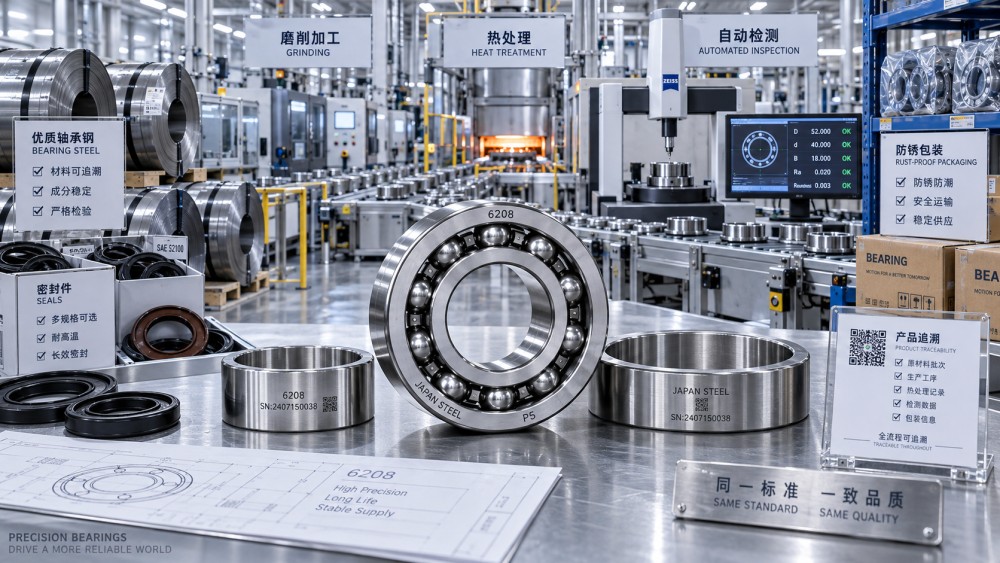
Why is material sourcing data often more revealing than inventory data?
A bearing cannot be replenished simply because a supplier has machining capacity. Long-term production depends on qualified inputs: bearing steel, stainless grades, specialty alloys, ceramic balls or rollers, cage material, seal elastomers, lubricant, plating chemicals, and packaging materials where corrosion protection is controlled. The availability risk is highest when a component relies on a narrow approved source base or a material grade that is purchased infrequently.
The useful supplier evidence is an approved-material specification linked to the part number, together with information on approved mills or processors, incoming material controls, and alternative-source qualification rules. Buyers do not necessarily need confidential commercial details, but they do need to know whether the supplier can change a mill or sub-tier source without affecting the bearing’s validated performance.
For through-hardened bearing steel, the material specification, cleanliness requirements, heat-treatment route, and retained-austenite control can influence fatigue performance. For stainless or corrosion-resistant bearings, composition, heat treatment, and passivation practice may matter. In hybrid bearings, ceramic rolling-element grade and dimensional matching are part of the performance system. A statement that “equivalent material may be used” should trigger further questions unless equivalence is defined through drawings, material standards, inspection requirements, and change-control approval.
Material resilience also includes geographic and trade exposure. If rings, rollers, cages, and final assembly are spread across jurisdictions, delivery continuity may be affected by transport constraints, import formalities, trade controls, or local production interruptions. The point is not to demand a fully domestic supply chain. It is to understand whether the supplier can identify its critical dependencies and provide a qualified route when one dependency fails.
How do quality records prove that future supply will still be usable?
Availability without repeatable quality is only nominal availability. A bearing supplied years later must perform within the design assumptions used by the original machine. Quality documentation establishes whether the supplier can reproduce the approved product rather than merely produce something with the same reference number.
Key records include controlled drawings, bills of materials, process flow documentation, control plans, inspection specifications, material certificates, and lot-level traceability. For critical applications, the documentation should show how inner rings, outer rings, rolling elements, cages, seals, and lubricant batches are linked to the finished bearing lot. The exact depth of traceability depends on the application, but a supplier should be able to explain the traceability boundary instead of making a broad claim that products are “fully traceable.”
Certificates to recognized quality-management systems may support confidence in process discipline, but certification is not proof that a particular bearing can be reproduced. The more direct evidence is the supplier’s retained product definition and change-control system. Ask what happens if a grinding machine, heat-treatment furnace, steel source, grease formulation, seal compound, or production site changes. Which changes require customer notification? Which require requalification? Who decides whether existing approval remains valid?
Formal change notification is especially important for bearings used in regulated equipment or assemblies with tightly controlled reliability validation. An unnoticed change in grease thickener, cage polymer, sealing lip geometry, or internal clearance can affect torque, noise, temperature capability, or service interval even where basic load ratings remain similar.
What delivery history should be examined?
Historical delivery performance is the most practical test of a supplier’s stated capability. It should be reviewed over a meaningful sequence of orders and separated by product family where possible. Corporate on-time delivery figures can hide a poor record for low-volume, engineered, or service-only bearing references.
Useful data includes confirmed lead time versus actual shipment date, the frequency and duration of delivery slippage, partial-shipment performance, backorder history, expedite dependence, and the causes assigned to late deliveries. A pattern matters more than a single late shipment. Delays caused by routine planning issues suggest a different risk than delays caused by a failed sub-tier supplier, unavailable tooling, quality holds, customs disruptions, or unplanned allocation to larger accounts.
Forecast adherence should also be discussed honestly. A supplier cannot reasonably guarantee short lead times for irregular demand that exceeds agreed forecasts. Conversely, a buyer should not accept forecasts as an excuse when the supplier has accepted a service commitment and repeatedly fails within the agreed planning window. The contractual and operational rules need to match: frozen forecast period, order flexibility, safety-stock ownership, replenishment trigger, and escalation procedure.
Can stock policies and service inventory provide meaningful proof?
They can, provided the policy is specific. A statement that a supplier “holds safety stock” is not enough. The useful questions are: Which part numbers are covered? Where is the inventory held? Is it finished stock, semi-finished rings, raw material, or vendor-managed stock? Is it reserved for a named customer or shared across the market? What is the replenishment lead time after withdrawal?
Finished-goods inventory offers the fastest response but can become obsolete if an approved revision changes. Semi-finished stock may be more flexible, particularly where rings can be completed into several variants, but it does not protect against unavailable cages, seals, rolling elements, or grease. Raw-material stock offers the weakest immediate protection, though it may be valuable for low-volume legacy parts whose steel or alloy is difficult to obtain.
For service-critical bearings, a stocking agreement should define ownership, shelf-life controls for lubricated or sealed products, inspection or rotation rules, inventory audit rights, and the disposition of stock if the equipment program ends. Bearings are not risk-free simply because they sit on a shelf: unsuitable storage conditions, damaged packaging, corrosion, and lubricant ageing can affect usability.
How should buyers assess a proposed substitute or successor bearing?
A supplier’s successor plan is credible only when it distinguishes commercial replacement from technical interchangeability. A new reference may share dimensions with the old one yet differ in raceway geometry, internal clearance, preload, contact angle, lubrication, sealing, cage dynamics, or permissible speed. Each difference can be harmless, beneficial, or unacceptable depending on the assembly.
Request a documented cross-reference showing every changed characteristic, the reason for the change, and the verification basis. For low-risk applications, dimensional and catalogue comparison may be sufficient. For precision or safety-relevant assemblies, the replacement may require fit checks, torque measurement, noise evaluation, thermal assessment, life calculation, endurance testing, or system-level validation. The required evidence should be decided by application risk rather than by the supplier’s preference for a simple substitution.
What data is commonly mistaken for proof?
Several familiar signals are useful but insufficient on their own. A large warehouse does not establish future manufacturing capability. A broad product catalogue does not prove support for a specific variant. A quality certificate does not prove material continuity. A low quoted lead time does not prove that the supplier can sustain low-volume aftermarket demand. Nor does a supplier’s long trading history show that its current factory, tooling, sub-tier network, and product strategy will remain unchanged.
Another mistake is treating a bearing standard as a complete product definition. Standards for dimensions, tolerances, or rating methods provide an essential common language, but they do not necessarily control every detail that affects application performance. The buyer’s approved specification must identify the attributes that cannot change without review.
What should be documented before relying on one source?
The most defensible decision record combines a part-level supply commitment, approved technical definition, change-notification terms, traceability expectations, material-source controls, lead-time evidence, and a practical plan for disruption or obsolescence. The plan may include qualified alternatives, a controlled lifetime-buy option, strategic inventory, or periodic review of supplier lifecycle status.
Long-term bearing availability is therefore not proved by a reassuring answer from sales or by a snapshot of stock. It is proved when the supplier can show how the product will continue to be made, how its inputs and process will remain controlled, how changes will be communicated, and how actual orders have been delivered. Where that evidence is strong, procurement risk becomes visible and manageable. Where it is absent, an apparently routine bearing can become a single point of failure in the equipment lifecycle.
Related News
- What Supplier Data Proves Long-Term Bearing Availability?Oct 13, 2026What supplier data proves long-term bearing availability? Discover the lifecycle, material, quality, capacity, and delivery records that reduce supply risk.
- When do sealed ball bearings outperform open bearings in dusty equipment?Sep 20, 2026Sealed ball bearings outperform open designs in dusty equipment when contamination control, grease retention, and low-maintenance reliability matter most. Explore key selection trade-offs.
- What lead-time risks should you check with a high performance bearings supplier?Sep 03, 2026High performance bearings supplier lead-time risks explained: check stock status, materials, capacity, approvals, logistics, and schedule evidence to protect uptime.
- What to verify before selecting a plain bearings manufacturerAug 31, 2026Choose a reliable plain bearings manufacturer with confidence. Verify materials, load ratings, tolerances, lubrication, quality controls, testing, and traceability before buying.
Related News
- 00
0000-00
How to vet North American fluid dynamics engineering firms for CFD - 00
0000-00
How to qualify a semiconductor equipment parts supplier for traceability - 00
0000-00
Does higher hardness improve heavy equipment abrasion resistance? - 00
0000-00
How to choose high-impact wear materials for mill liners - 00
0000-00
Which fluid power components for pneumatics suit high-cycle automation?
Tribology Specialist
Strategic Intelligence Center