








Choosing high-impact wear materials for mills requires more than comparing hardness values. Start by identifying whether impact fracture, abrasive loss, or liner geometry limits performance.
The strongest candidate balances toughness and wear resistance under your actual ore, grinding media, and operating conditions, while meeting installation and maintenance requirements.
For technical evaluators, the decision should connect material properties to documented failure modes, comparable operating evidence, supplier quality controls, and lifecycle cost per tonne.
This guide explains how to assess manganese steel, alloy steels, and rubber-metal composites, challenge supplier claims, and build a defensible specification for reliable grinding performance.
Identify What Is Actually Limiting Liner Life
Before requesting a different material, examine retired liners and operating records. A liner removed for cracking presents a different selection problem from one worn uniformly.
Map damage by location: feed end, shell, lifter face, discharge end, bolt holes, and transitions between sections. Local conditions often justify different material choices.
Record remaining thickness, crack location, deformation, loose fasteners, and changes in lifter profile. Photographs become more useful when linked to operating hours and processed tonnes.
Distinguish abrasive thinning from impact spalling and fatigue cracking. These mechanisms can coexist, so the visible damage alone may not explain the underlying cause.
For example, cracks around bolt holes can reflect stress concentration, inadequate support, installation errors, or casting defects. Increasing bulk hardness may worsen the problem.
Also establish the removal criterion. Minimum thickness, unacceptable cracking, reduced grinding performance, or a scheduled shutdown can each produce a different reported liner life.
Your initial specification should state the dominant failure mechanism and supporting evidence. This keeps material selection focused on a measurable problem rather than general durability.
Build an Operating Envelope Before Comparing Materials
Impact severity depends on mill diameter, rotational speed, charge motion, media size, and liner geometry. Mill type alone cannot determine the correct material family.
Large SAG mills can expose liners to substantial rock and ball impacts. Ball mills may emphasize abrasion, although operating conditions still create significant impact loads.
Collect feed size distribution, maximum credible lump size, ore variability, media diameter, ball charge, filling level, throughput, and speed expressed relative to critical speed.
Include slurry solids, pH, temperature, and relevant water chemistry where applicable. Corrosion can interact with abrasion and alter the ranking of otherwise promising materials.
Assess ore abrasiveness separately from ore hardness or grindability. An ore requiring substantial grinding energy does not automatically produce the highest liner wear rate.
Document abnormal operation, including low charge levels, startup conditions, and feed interruptions. Occasional severe impacts may govern cracking even when average operation appears moderate.
Define both the normal operating range and credible excursions. Suppliers should explain how their proposed material and liner design address each part of that envelope.
Which Material Family Fits Your Failure Mechanism?
No material family consistently wins across all mills. Use the following comparison to create a shortlist, then validate the proposed grade and finished liner design.
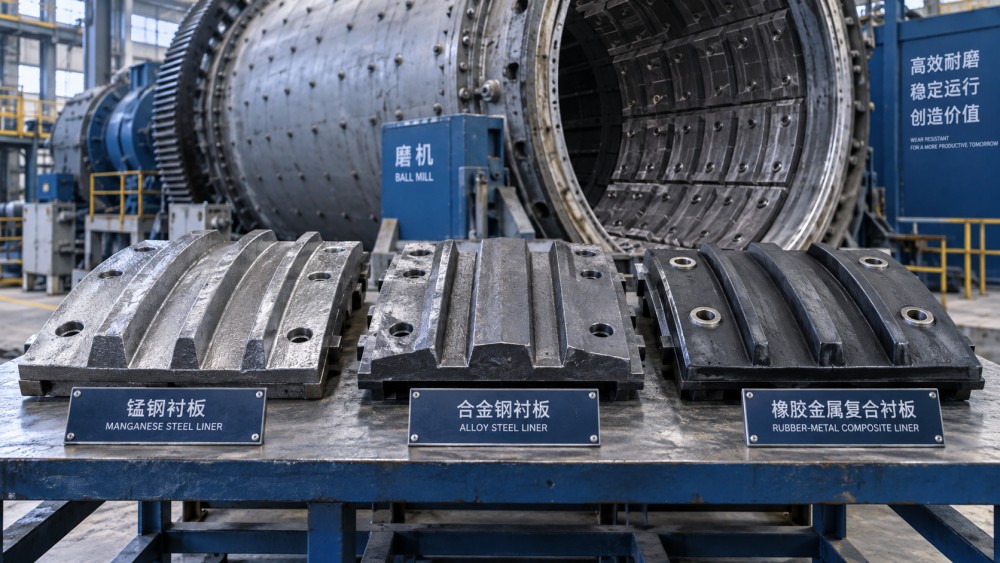
Consider manganese steel where toughness and substantial surface deformation are valuable. Its work-hardening benefit depends on actual loading, not simply the presence of grinding media.
Under insufficient contact stress, manganese steel may not develop the desired hardened surface. Under substantial loading, deformation may still compromise lifter geometry or fastening clearances.
Alloy steels offer flexibility through composition and heat treatment. Evaluate the resulting microstructure and section properties rather than treating a grade designation as guaranteed performance.
Rubber-metal composites can combine resilient support with strategically placed metal wear surfaces. Their suitability depends on insert geometry, retention, rubber formulation, and operating temperature.
Rubber systems can reduce liner mass and noise in appropriate applications. However, installation benefits and wear performance must be verified for the particular assembly.
High-chromium white iron deserves consideration where abrasion dominates and impact is controlled. Avoid extrapolating successful low-impact service to locations exposed to severe direct strikes.
How Much Hardness Can You Accept Without Losing Toughness?
Hardness is useful for assessing consistency and some aspects of abrasion resistance. It does not directly establish resistance to impact cracking, fatigue, or spalling.
Two liners with similar hardness can behave differently because of carbide distribution, grain structure, residual stress, casting defects, and heat treatment through the section.
Request an acceptable hardness range with defined measurement locations and methods. A single surface reading can conceal variation between thin features and thick sections.
Ask suppliers to identify the intended microstructure and explain how production controls achieve it. This is particularly important when cooling rates vary across complex castings.
Impact test results require context: specimen size, notch geometry, orientation, test temperature, and sampling location all affect interpretation. Compare results only under compatible conditions.
Standard impact tests support material assessment but do not reproduce mill service. Combine laboratory evidence with representative field data and analysis of observed failures.
For severe impact locations, prioritize demonstrated resistance to fracture before pursuing additional hardness. Then assess whether the remaining wear rate meets your maintenance target.
Evaluate the Liner as a System, Including Geometry and Fastening
A material change can fail if the liner profile generates unfavorable impacts. Lifter height, face angle, spacing, and worn shape influence charge trajectories and grinding.
Evaluate the proposed profile at installation and near its intended replacement condition. A long-lasting liner may still become economically unsuitable as its geometry deteriorates.
Charge-motion simulation can support comparisons, provided assumptions represent actual operation. Validate predictions against plant observations rather than treating a simulated trajectory as conclusive evidence.
Review bolt-hole geometry, bearing surfaces, backing requirements, segment fit, and fastening procedures. Inadequate support or preload can promote movement, leakage, fatigue, and localized damage.
Check individual segment mass against liner handler capacity, lifting arrangements, and available access. Lower mass can improve handling, but installation time depends on assembly complexity.
Consider discharge components alongside shell liners. Changes affecting grate openings, pulp flow, or internal volume can alter throughput independently of the material's wear resistance.
Where conditions differ substantially across the mill, consider a zoned specification. Uniform material selection is convenient, but local impact and abrasion may justify different solutions.
What Evidence Should a Supplier Provide?
Request references from mills with comparable diameter, speed, ore abrasiveness, feed size, and media conditions. Similar industry labels provide little assurance of similar loading.
Supplier comparisons should identify the previous liner, replacement criterion, processed tonnes, operating hours, and relevant production changes. Otherwise, claimed improvements may reflect easier service.
Ask for material traceability connecting each supplied liner to its heat, chemistry, heat treatment, and inspection records. Certificates should relate to the delivered components.
Define inspection requirements around critical features and likely defects. Appropriate methods and acceptance criteria depend on the material, geometry, manufacturing route, and failure consequences.
For composites, examine insert retention, bond quality controls, rubber compatibility, and expected failure modes. Request evidence covering both wear performance and structural integrity in service.
Treat laboratory abrasion results as screening evidence unless their relationship to your service is demonstrated. Different test mechanisms can produce different rankings among materials.
A credible proposal explains uncertainties, identifies operating limits, and offers a practical validation plan. Unsupported percentages of longer life should carry little selection weight.
Compare Cost per Tonne and Production Effects
Purchase price is only one part of liner economics. Include freight, installation labor, handling equipment, inspection, replacement parts, and disposal or recycling where relevant.
Estimate downtime using your plant's actual economic constraints. Lost production value depends on bottlenecks, available capacity, recovery opportunities, and contribution margin rather than revenue alone.
A practical starting metric is total attributable liner cost divided by tonnes processed during the campaign. Define included costs consistently before comparing competing proposals.
Track throughput and specific energy alongside liner expenditure. Preserving an effective lifter profile may create more value than extending service after grinding performance has declined.
Also consider whether additional liner life changes the shutdown schedule. A longer campaign delivers limited availability benefit if another component still requires the same outage.
Use sensitivity analysis for uncertain life, installation duration, and production effects. A candidate that remains attractive under conservative assumptions offers a stronger economic case.
Assess end-of-life handling using actual local options. Mixed rubber-metal assemblies may require separation, while contaminated or mixed alloys can affect recycling acceptance and value.
Validate the Shortlist Through a Controlled Trial
Set acceptance criteria before installation: allowable cracking, minimum residual thickness, profile retention, fastening integrity, throughput, energy consumption, and target cost per tonne over the campaign.
Record a baseline using current liners and comparable operating periods. Without baseline data, a successful campaign may remain difficult to attribute to the new material.
Use staged evaluation where practical, while considering system interactions. Changing only selected segments may alter load distribution and may require approval from the mill designer.
Inspect at planned intervals with consistent measurement locations and methods. Track wear rate and crack development against processed tonnes, operating hours, and major operating changes.
Do not assume wear progresses linearly. Geometry evolution, seasonal ore changes, and shifting operating conditions can make early measurements unreliable predictors of total campaign life.
Investigate unexpected damage before expanding the trial. Preserve failed components and production records so analysis can distinguish material deficiencies from installation or operating causes.
Advance a candidate when it meets agreed technical and economic criteria across representative conditions. Retain enough documentation to support repeat procurement and subsequent performance reviews.
Choose the Material That Protects Reliable Grinding Performance
Selecting high-impact wear materials for mills starts with a documented failure mechanism and operating envelope. Material properties become useful when connected to those service conditions.
Shortlist material families by impact and abrasion demands, then assess finished liner quality, geometry, fastening, and handling. Validate supplier evidence against comparable operating experience.
The preferred liner delivers acceptable fracture resistance, controlled wear, and effective grinding throughout its campaign. Its economic value should survive realistic assumptions about plant operation.
Make the final decision through a measurable specification and controlled trial. That approach turns material selection into an accountable engineering decision with evidence for future improvements.