








When a production line begins to show intermittent vibration, rising bearing temperature, or a change in motor current, the equipment may still be running well enough to meet today’s schedule. The risk is that a bearing defect rarely remains stable. A minor lubrication issue, mounting error, or early raceway defect can progress until the machine must be stopped without warning, often at the least convenient point in the operating cycle.
Can predictive maintenance reduce unplanned bearing downtime? Yes—when it is used to detect developing faults early enough to plan a controlled intervention. Predictive maintenance does not make bearings immune to failure, and it cannot correct poor installation or unsuitable operating conditions by itself. Its value is earlier visibility: it helps maintenance teams distinguish a normal operating change from a developing defect, prioritize the right asset, prepare parts and labor, and replace or repair a bearing before secondary damage forces an emergency shutdown.
Why bearing failures still become unplanned events
Bearings often fail because the warning signs are not connected to a practical maintenance decision. An operator may hear a rougher sound but not know whether it is a bearing, gearbox, belt, coupling, or process-related change. A technician may record a high temperature reading, yet the reading alone may not show whether the issue is lubrication condition, excessive preload, inadequate clearance, contamination, or load variation.
Time-based maintenance also has limits. Replacing every bearing at a fixed interval can remove parts that still have useful life, while an apparently identical bearing may fail earlier because its actual duty is different. Speed changes, shock loading, washdown exposure, shaft deflection, lubricant selection, sealing performance, and installation quality all affect the real condition of the bearing.
The result is a familiar maintenance dilemma: wait until the fault is obvious and risk collateral damage, or replace components too early and consume labor, inventory, and planned downtime. Predictive maintenance provides a way to make that decision from condition evidence rather than calendar age alone.
What predictive maintenance can reveal before failure
A useful program does not rely on one instrument or one alarm threshold. Bearing degradation has stages, and the most informative signal changes with the fault type and its maturity. The objective is to establish a credible baseline, identify deviation, then confirm whether the deviation is persistent and relevant to the machine’s operating state.
- Vibration analysis can detect characteristic frequencies associated with the inner race, outer race, rolling elements, cage, looseness, imbalance, or misalignment. High-frequency techniques may identify very early impacts from localized defects before overall vibration rises substantially.
- Temperature monitoring is useful for detecting friction, lubrication problems, excessive load, or abnormal fit. It is most valuable when compared against the bearing’s own normal temperature at similar speed, load, and ambient conditions.
- Lubricant and wear-debris inspection can reveal contamination, water ingress, oxidation, incorrect lubricant mixing, or metallic particles. In circulating oil systems, oil condition can provide important evidence before a major bearing event.
- Ultrasound and acoustic methods may help identify inadequate lubrication or early surface distress, particularly where vibration access is limited or where slow-speed equipment produces weak conventional vibration signals.
- Process and electrical data can add context. Motor current, load, speed, pressure, and throughput changes can explain why a signal moved—or expose a mechanical problem that would otherwise be mistaken for a process variation.
None of these measurements should be treated as automatic proof of a bearing failure. A rise in temperature after a grease change, for example, may reflect temporary churning or over-greasing. A vibration peak can be caused by a damaged gear, a loose base, resonance, or another rotating component. The reduction in downtime comes from combining data with machine knowledge and responding before the fault reaches a destructive stage.
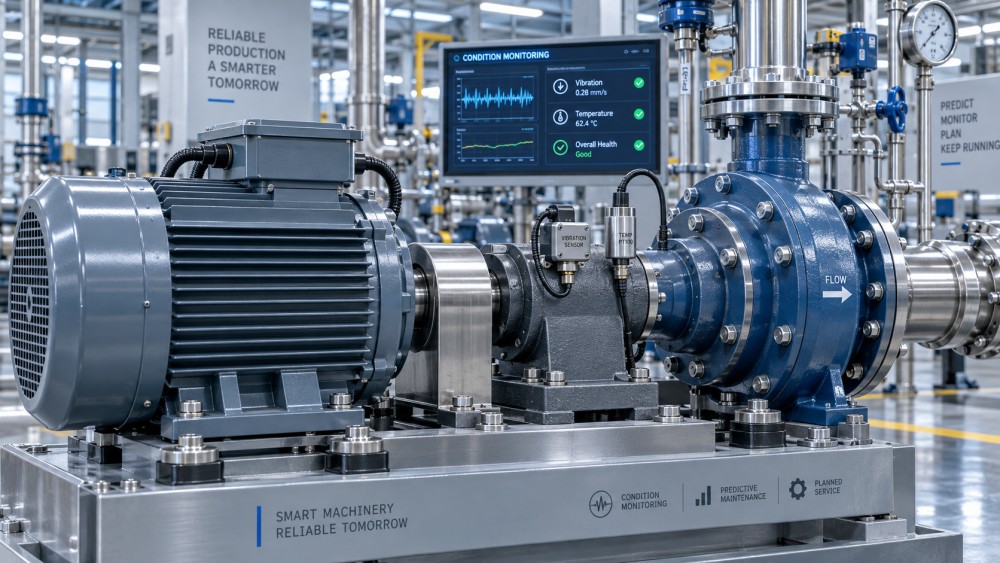
Start with equipment where warning time has operational value
Not every bearing position requires the same monitoring effort. A small, easily replaced bearing in noncritical auxiliary equipment may be managed with routine inspection and basic preventive practices. Continuous monitoring is usually more justified where a failure stops a constrained process, causes safety concerns, risks expensive adjacent components, or requires difficult access and long repair preparation.
Prioritization should consider more than the purchase price of the bearing. Ask what happens when that position fails: Does it damage a shaft, housing, gearbox, seal, or driven component? Is the spare readily available? Can the machine be isolated without stopping the wider line? Does replacement require alignment work, lifting equipment, or a lengthy cool-down period? A bearing with modest component cost can still carry high downtime exposure.
Turning a warning into a planned repair
The difficult part is not collecting readings; it is deciding what action a reading should trigger. A productive workflow separates detection, confirmation, and intervention. Treating every alert as an emergency creates alarm fatigue. Ignoring alerts until a bearing becomes noisy defeats the purpose of monitoring.
1. Establish a meaningful reference condition
Record baseline readings after confirming that the equipment is correctly installed, adequately lubricated, and operating under known conditions. Include speed, load, product state, ambient temperature, and measurement location. A baseline taken during abnormal operation can make later comparisons misleading.
2. Trend changes instead of reacting only to a single reading
A gradual rise in vibration energy, repeated impacts in an expected bearing-frequency region, or a steadily increasing temperature difference may be more important than one isolated high value. Trend direction and rate of change help determine urgency. A stable deviation may justify closer observation; a rapidly worsening pattern may require repair planning at the next safe opportunity.
3. Confirm the fault mechanism
Before ordering a replacement bearing, verify the probable cause. Check lubrication type and quantity, relubrication intervals, contamination paths, seal condition, alignment, shaft and housing fits, clamp or locknut condition, and transmitted load. A replacement installed into the same damaging environment may fail in the same way.
Vibration spectra and time waveforms can help differentiate common patterns, but they must be interpreted with care. Outer-race damage often produces a relatively stable fault frequency because the defect remains fixed in the housing load zone. Inner-race defects can vary as the defect rotates through the load zone. Rolling-element and cage-related signatures may be less consistent, particularly as slip or speed variation changes. These are diagnostic clues, not substitutes for inspection.
4. Plan the work around the actual failure window
A condition diagnosis should produce a practical work order: required bearing specification, compatible lubricant, seals, locking hardware, tools, heating method where appropriate, lifting needs, alignment checks, and post-installation measurements. The available warning period is valuable only when it is converted into preparation. Scheduling a controlled stop is usually less disruptive than responding after a seized bearing damages the shaft or housing.
Common mistakes that weaken the program
Using only temperature as a bearing-health indicator. Temperature is easy to obtain, but many bearing defects generate measurable vibration changes before they create a large thermal change. Conversely, a warm bearing may be operating acceptably under a higher load. Use temperature as context, not as the sole diagnostic tool.
Setting generic alarm limits without machine history. Absolute limits can be useful as a safeguard, yet a low reading may still be abnormal for a particular machine, while a higher stable reading may be normal for another. Asset-specific baselines and operating context improve interpretation.
Monitoring symptoms while ignoring root causes. Grease contamination, improper relubrication, misalignment, soft foot, electrical discharge, incorrect internal clearance, and poor mounting practice can all shorten bearing life. Predictive maintenance should lead to corrective action on the cause, not merely repeated replacement.
Collecting inconsistent route data. Measurement point, sensor direction, mounting method, machine speed, and operating state influence results. A trend is unreliable when readings are taken from different locations or under widely different conditions without documentation.
Assuming every detected defect requires immediate shutdown. Severity depends on fault progression, load, redundancy, consequence of failure, and the potential for secondary damage. Some conditions can be monitored at a shorter interval while maintenance is planned. Others require rapid action because the risk escalates quickly. The decision should be based on evidence and consequence, not on an alert alone.
Installation and lubrication remain part of predictive maintenance
Condition monitoring cannot compensate for avoidable installation errors. During a planned bearing change, inspect the shaft and housing surfaces for damage, corrosion, fretting, or out-of-tolerance fits. Confirm the correct bearing designation, clearance class where relevant, orientation, preload or endplay requirements, and mounting force path. Pressing through the rolling elements, striking a ring directly, or using uncontrolled heating can introduce damage before the machine returns to service.
Lubrication deserves the same discipline. The right grease or oil must match speed, load, temperature, sealing arrangement, and compatibility requirements. Too little lubricant can accelerate metal-to-metal contact; too much grease can raise operating temperature and churn losses. A dirty grease gun, open filler point, damaged seal, or mixed lubricant can undermine an otherwise sound predictive strategy.
After installation, capture a new reference condition once the machine has stabilized. That reading helps identify early problems such as misalignment, abnormal preload, or assembly-related damage before they become a repeat outage.
Questions maintenance teams often ask
How early can predictive maintenance detect a bearing problem?
It depends on bearing type, speed, load, defect location, sensor quality, and the monitoring method. Surface distress may create high-frequency impacts before it produces obvious noise or heat, while some slow-speed applications are harder to assess with standard vibration measurements. The important measure is whether the program provides enough warning to confirm the issue and schedule work safely.
Is continuous monitoring necessary for every bearing?
No. Continuous sensors are most useful when the asset is critical, inaccessible, fast-changing, or expensive to stop unexpectedly. Periodic route-based monitoring can be effective for stable, lower-risk equipment, provided the inspection interval is short enough to catch meaningful changes.
Can predictive maintenance prevent all bearing failures?
No monitoring method can eliminate every failure. Sudden external damage, severe contamination, electrical events, operating misuse, and rapidly developing defects can still occur. Predictive maintenance reduces exposure by finding many developing conditions earlier and by improving the quality of repair decisions.
What should trigger an immediate investigation?
Rapidly rising vibration or temperature, audible roughness, visible lubricant leakage or discoloration, repeated abnormal alarms, excessive shaft movement, or signs that the bearing is damaging adjacent components warrant prompt review. Where failure could create a safety hazard or major mechanical damage, follow the site’s escalation and shutdown procedures rather than waiting for the next routine route.
Related News
- When do precision ground gears reduce noise in high-speed gearboxes?Oct 17, 2026Precision ground gears can reduce high-speed gearbox noise when flank errors drive mesh excitation. Discover how optimized geometry and controlled testing verify quieter performance.
- How to choose gear materials for high-load industrial gearboxesOct 15, 2026Choose gear materials for high-load industrial gearboxes with confidence. Compare steel grades, heat treatments, and quality checks to reduce failures and improve service life.
- How to choose engineering plastics for gears without lubricationOct 14, 2026Choose engineering plastics for gears without lubrication. Compare POM, PA and PEEK, assess wear and heat, and discover how to validate reliable dry-running performance.
- What straightness checks should a guide component factory provide?Oct 18, 2026What should an industrial guide components factory prove? Discover essential straightness checks, support conditions, and traceable reports to verify quality before you buy.
Related News
- 00
0000-00
Can fluid power systems for robotics deliver precise motion control? - 00
0000-00
How to control design changes when working with an OEM supplier - 00
0000-00
When do precision ground gears reduce noise in high-speed gearboxes? - 00
0000-00
How pressure ratings affect the price of flow control components - 00
0000-00
How to choose gear materials for high-load industrial gearboxes
Tribology Specialist
Strategic Intelligence Center