





From aerospace housings to chemical processing lines, high-performance composites are trusted for strength, weight reduction, and corrosion resistance. Yet in harsh environments, these advanced materials can fail unexpectedly when heat, moisture, cyclic loads, and aggressive media interact with hidden design or quality risks. For quality control and safety managers, understanding why high-performance composites fail is essential to preventing downtime, compliance issues, and costly operational hazards.
In precision manufacturing, failure rarely comes from one visible defect alone. More often, it develops through a chain of small mismatches: an resin system chosen for 120°C service but exposed to 160°C peaks, a laminate designed for dry conditions but installed where moisture uptake reaches 1% to 3%, or a bonded interface that sees vibration frequencies far beyond validation testing. For teams responsible for quality assurance and plant safety, these details directly affect inspection criteria, supplier qualification, and long-term risk control.
For industrial intelligence platforms such as GPCM, the topic is especially relevant because composite reliability sits at the intersection of materials science, tribology, fluid exposure, and precision tolerancing. Whether the application involves structural covers, bearing cages, valve components, chain guides, or corrosion-resistant panels, the same question remains: why do high-performance composites fail in harsh environments, and what can decision-makers do before those failures become incidents?
How harsh environments accelerate composite failure mechanisms
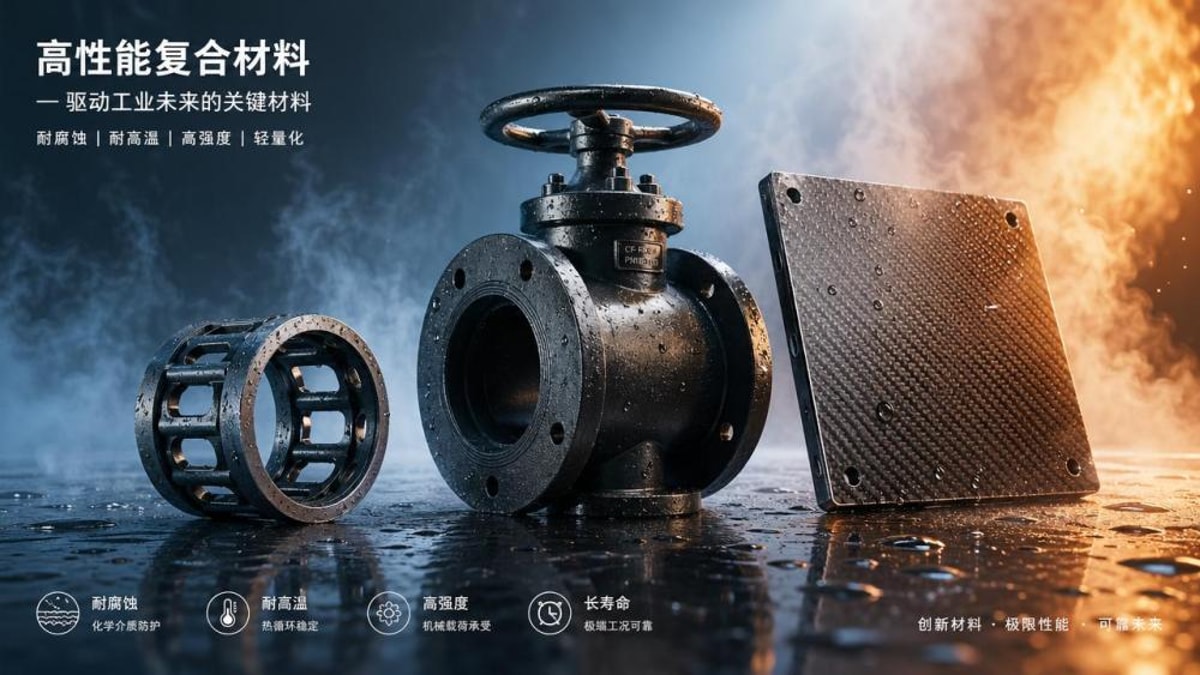
High-performance composites are not a single material family. They include carbon fiber, glass fiber, aramid-reinforced systems, thermoset laminates, thermoplastic composites, filled polymers, and hybrid structures. In controlled service, many of these materials deliver excellent stiffness-to-weight ratios and corrosion resistance. In harsh environments, however, performance depends on how fibers, matrix, interface, and manufacturing quality behave under combined stress rather than isolated lab conditions.
The most common accelerants are thermal cycling, moisture ingress, chemical attack, UV exposure, abrasion, and repeated mechanical loading. A component may tolerate 10,000 load cycles in dry ambient air, then lose margin rapidly when exposed to salt spray, steam, or hydraulic fluid contamination. The danger for quality managers is that visible surface appearance may remain acceptable even while internal delamination, matrix cracking, or fiber-matrix debonding has already started.
In industrial settings, harsh conditions are often mixed rather than singular. A valve enclosure near a processing line may see 80°C operating temperature, daily washdown, pH variation from 3 to 11, and vibration from rotating equipment. Under those conditions, even a well-specified composite can underperform if its service envelope was validated only for static loading or short-duration exposure. Safety managers therefore need failure analysis criteria that account for real-world combinations, not idealized single-variable tests.
Primary degradation pathways
The matrix phase is often the first weak point under hostile service. Epoxy, phenolic, PEEK, PPS, and other matrices each have different glass transition temperatures, chemical compatibility windows, and moisture sensitivities. Once the matrix softens, swells, or micro-cracks, load transfer to the reinforcing fibers becomes unstable. That does not always produce immediate fracture, but it can reduce dimensional stability, fatigue resistance, and seal integrity within weeks or months instead of the intended 3 to 5 years.
The interface between reinforcement and matrix is equally important. In many high-performance composites, interfacial adhesion controls impact behavior and long-term fatigue life. If surface treatment, cure profile, or contamination control is inadequate, the composite may pass basic incoming inspection but fail under cyclic service. This is one reason why two parts with the same nominal fiber content can behave very differently after 500 hours of salt fog or 1,000 thermal cycles.
Geometry also matters. Sharp corners, drilled holes, cutouts, and bonded joints create local stress concentrations. In aggressive environments, a stress concentration factor of 2 or 3 can become the trigger point for crack initiation, especially where moisture or chemicals enter through exposed edges. For safety-critical parts, quality plans should treat edge finishing and hole preparation as process-critical steps rather than cosmetic details.
Typical harsh-environment stress combinations
- Temperature exposure from -40°C to 150°C with daily thermal cycling that causes differential expansion between inserts, fibers, and matrix.
- Humidity or immersion conditions where moisture uptake can gradually alter stiffness, mass, and dielectric behavior over 30 to 180 days.
- Cyclic loads above 1 million repetitions in conveyors, pump systems, motion assemblies, or protective structures attached to vibrating equipment.
- Chemical contact with acids, alkalis, solvents, fuels, hydraulic oils, or process gases that attack resin systems and edge-sealed interfaces.
The most common root causes behind unexpected failure
When high-performance composites fail unexpectedly, the root cause often lies upstream in design assumptions, material selection, process control, or validation gaps. Many organizations still evaluate composites with the same mindset used for metals: checking tensile strength, hardness, and visual finish while underestimating anisotropy, environmental aging, and interlaminar weakness. For quality control teams, this creates blind spots that only appear after installation.
One frequent issue is overreliance on nominal datasheet values. A supplier may quote room-temperature flexural strength or dry-condition modulus, but these values can fall significantly at elevated temperatures or after fluid exposure. If a component operates at 120°C and spends 20% of its time near pressure pulsation or shock loads, acceptance based only on standard ambient testing is inadequate. A robust review should compare nominal properties, conditioned properties, and end-use load cases side by side.
Another common cause is process variability. Void content, resin-rich zones, incomplete cure, fiber waviness, misaligned layup, and poor post-processing all affect durability. In precision applications, even a dimensional shift of 0.2 mm to 0.5 mm can increase contact stress, disturb sealing, or misalign adjacent power transmission components. That is why harsh-environment performance cannot be separated from manufacturing discipline.
Root-cause matrix for quality and safety teams
The table below summarizes the most frequent causes of failure observed across industrial composite applications and the practical signals that quality and safety managers should monitor during supplier audits, incoming inspection, and in-service review.
The key conclusion is that failure rarely starts with one catastrophic event. In most cases, a preventable mismatch exists between expected and actual service conditions. For buyers and compliance teams, the purchasing specification should therefore include environmental limits, inspection checkpoints, and validation duration, not just part geometry and unit price.
Frequent specification mistakes
- Using short-term peak temperature as the only thermal criterion instead of checking continuous operating temperature and thermal cycling frequency.
- Ignoring moisture diffusion through edges, drilled features, and bonded interfaces, especially in outdoor or washdown environments.
- Approving a composite based on corrosion resistance alone while overlooking fatigue, creep, impact, or abrasion behavior.
- Applying metallic fastener torque values to composite joints without validating local crushing or interlaminar damage risk.
What quality control should inspect before approval and during service
For quality control personnel, the challenge is not simply detecting defects but building an inspection plan that matches how high-performance composites actually degrade. A good plan starts at supplier qualification, continues through first article inspection, and extends into periodic field review. In harsh environments, a single inspection at delivery is rarely enough because damage may develop slowly after 3 months, 6 months, or 12 months of exposure.
Incoming inspection should focus on dimensional consistency, laminate quality, edge condition, cure evidence, insert integrity, and documentation completeness. Where the application is safety-relevant, non-destructive examination methods such as ultrasonic testing, tap testing, thermography, or visual magnification may be justified depending on part geometry and risk class. Even simple controls like weight comparison against a validated baseline can help detect resin variation or void-related anomalies.
During service, inspection intervals should be matched to environment severity. A component exposed to intermittent splash and low vibration may be checked every 6 to 12 months, while one operating in continuous chemical mist and cyclic loading may require review every 4 to 8 weeks during the first year. Safety managers should also define clear removal criteria so operators do not continue using parts that show early delamination, fiber exposure, or seal-line cracking.
Inspection priorities by lifecycle stage
The following table can be adapted into a control plan for industrial composite components used in equipment covers, transmission assemblies, fluid-control housings, and corrosion-resistant structures.
This approach helps quality teams move from reactive replacement to predictive control. In many facilities, the most valuable improvement is simply documenting inspection trends rather than isolated pass/fail decisions. A small increase in crack length, moisture-related weight gain, or torque relaxation can provide a 2- to 8-week warning before more serious failure appears.
A practical 5-step control routine
- Confirm the actual operating envelope, including temperature peaks, media contact, load frequency, and cleaning chemistry.
- Match that envelope to conditioned material data rather than room-temperature brochure values.
- Define 4 to 6 critical inspection characteristics such as edge integrity, laminate uniformity, insert bonding, and dimensional stability.
- Set review intervals based on risk severity, with shorter cycles during the first 90 days of field exposure.
- Escalate any recurring anomaly into supplier corrective action before expanding volume purchases.
How to reduce safety risk through better design, selection, and validation
For safety managers, prevention starts before procurement. The best-performing high-performance composites in harsh environments are usually those selected through application-specific validation rather than generic substitution. If a composite part replaces metal, the team should reassess not only weight savings and corrosion resistance but also impact tolerance, fire behavior, electrical properties, creep, and repairability. A lighter component is not automatically a safer one if failure mode changes from visible yielding to hidden delamination.
Design mitigation measures can significantly extend life. Generous radii, protected edges, compatible inserts, controlled fastener torque, abrasion shields, and environmental barriers often provide more value than simply choosing a more expensive material grade. In chemical plants, for example, edge sealing and splash shielding can reduce direct media ingress. In motion systems, reducing local vibration amplitude by even 10% to 15% may improve fatigue life more than increasing laminate thickness alone.
Validation should reflect actual service combinations. A meaningful program may include 3 stages: baseline mechanical testing, environmental conditioning, and post-conditioning residual strength evaluation. Depending on risk level, this may involve 250, 500, or 1,000 hours of conditioned exposure, followed by flexural, compression, impact, or leak-related tests. The goal is not perfect simulation of every site condition but a realistic safety margin against the most credible combined stresses.
Selection criteria for harsh-duty applications
- Thermal margin: choose systems whose continuous service temperature remains above expected operating temperature by at least 15°C, and more where cycling is severe.
- Chemical compatibility: review exposure not only to the main process fluid but also to cleaners, lubricants, condensate, and accidental splash conditions.
- Mechanical mode: check whether the part sees tension, compression, bending, impact, wear, or combined loading over more than 105 cycles.
- Inspection accessibility: prefer designs that allow visual or non-destructive review of critical edges, joints, and stress zones.
Design and validation checklist
A reliable validation process should answer four practical questions. First, is the material system suitable after conditioning, not only before conditioning? Second, are joints, inserts, and edges protected against local stress and chemical ingress? Third, does the test duration cover early aging behavior rather than only short-term exposure? Fourth, are pass criteria linked to actual safety and function, such as leak tightness, alignment, or retained strength above a defined threshold?
Organizations that manage these questions early usually reduce unplanned field changes, quarantine events, and maintenance disputes later. This is particularly important for distributors, OEMs, and plant operators sourcing critical motion or fluid-control components through multi-tier supply chains. Reliable high-performance composites depend as much on specification discipline and supplier communication as on material chemistry itself.
Procurement, supplier communication, and long-term reliability planning
For B2B buyers, procurement decisions often determine whether a composite component becomes a reliability asset or a recurring nonconformance. Purchasing teams should avoid comparing suppliers only on unit cost, quoted lead time, or generic strength claims. In harsh environments, a lower-cost part can become more expensive if it requires a 6-month replacement cycle, added inspections, or emergency shutdown risk. Total lifecycle evaluation is more relevant than first-cost comparison.
A strong purchase specification should include at least 6 elements: material system, environmental limits, mechanical load case, inspection method, documentation package, and change-control obligations. If the component affects safety, the buyer should also define requalification triggers such as resin change, fiber source change, cure profile adjustment, geometry modification, or relocation of production. These controls help prevent silent drift in performance from one batch to the next.
This is where industrial intelligence platforms such as GPCM add value. By connecting material science trends, component application knowledge, and commercial supply-chain insight, procurement and engineering teams can make more informed decisions on long-life composite bearings, guides, housings, and fluid-control parts. Better upstream intelligence reduces downstream corrective action, especially in sectors where precision, uptime, and safety compliance are tightly linked.
Questions buyers should ask suppliers
- What conditioned-property data is available after humidity, thermal cycling, or chemical exposure, and how long was the exposure period?
- Which manufacturing variables are controlled lot to lot, and what records can be reviewed during audit?
- What are the recommended inspection intervals and removal criteria in severe duty service?
- How are design changes, raw-material substitutions, or process updates communicated and revalidated?
Final perspective
High-performance composites fail in harsh environments not because the technology is inherently unreliable, but because real service conditions often exceed the assumptions built into design, testing, or procurement. The most effective countermeasure is a disciplined framework that combines material selection, process control, application-specific validation, and field inspection. For quality control and safety managers, that framework turns composites from a hidden risk into a manageable engineering asset.
If your team is evaluating composite components for demanding industrial duty, now is the right time to review specifications, inspection plans, and supplier data before failure appears in service. Contact GPCM to discuss technical intelligence, sourcing evaluation, and application-focused guidance, or request a tailored solution for precision components operating under harsh environmental conditions.
Related News
- How to Shortlist a Precision Engineering Supplier for Repeatable QualityMay 05, 2026Precision engineering supplier selection starts with repeatable quality. Learn how to shortlist vendors by tolerances, inspection, materials, and supply reliability.
- Evolutionary Trends in Precision Engineering: What Is Changing in Supplier CapabilitiesMay 05, 2026Evolutionary trends in precision engineering are redefining supplier capabilities—from tighter tolerances to smarter quality systems. Discover how to assess technical credibility and sourcing resilience.
- When Precision Manufacturing OEM Makes Sense Over In-House ProductionMay 05, 2026Precision manufacturing OEM makes sense when in-house production adds hidden cost, quality risk, or delays. Learn when outsourcing improves precision, speed, and project results.
- How to Compare a Precision Machining Manufacturer Without Missing Critical TolerancesMay 05, 2026Precision machining manufacturer comparison starts with critical tolerances, process control, and inspection proof. Learn how to reduce quality risk and choose a supplier with confidence.
Related News
- 00
0000-00
Industrial Automation Components Supplier: Key Compliance Checks Before Scaling Orders - 00
0000-00
How to Shortlist a Precision Engineering Supplier for Repeatable Quality - 00
0000-00
Evolutionary Trends in Precision Engineering: What Is Changing in Supplier Capabilities - 00
0000-00
When Precision Manufacturing OEM Makes Sense Over In-House Production - 00
0000-00
Hydraulic Valve Blocks for Precision Engineering: What Affects Service Life Most
Dr. Alistair Vaughn
Strategic Intelligence Center