








Dual sourcing makes sense when a component can stop production, the current supply route is vulnerable, and a second qualified supplier can deliver usable parts before existing stock runs out. The protection must justify the added cost of qualification, smaller order volumes, inventory, and supplier management.
In industrial components sourcing, a second quotation is only the beginning. Two suppliers provide meaningful resilience when their parts meet the same application requirements, their supply chains have enough independence, and their available capacity supports a realistic switch. If either supplier needs extensive engineering work before its parts can be used, the arrangement offers less protection than it appears to.
The decision should therefore start with the consequence of losing supply and the time required to recover. Unit price matters, but it cannot explain whether a second source will keep equipment running.
Start with the gap between stock coverage and recovery time
A low-cost bearing, seal, or coupling can become a major business risk if its absence prevents a machine from shipping or a production line from operating. Rank components by what happens when they are unavailable, including whether a substitute exists, whether equipment can operate temporarily without them, and how long replacement takes.
Then compare usable inventory coverage with realistic recovery time. Recovery includes detecting the disruption, placing an order, obtaining production capacity, manufacturing the part, transporting it, inspecting it, and releasing it for use. An advertised lead time may cover only part of that sequence.
If inventory is likely to run out before the primary supplier recovers, dual sourcing deserves serious consideration. However, the alternative supplier must close that gap. A second manufacturer with an equally long lead time and no reserved capacity may add little immediate protection.
Demand variability changes the calculation. Stock that covers ordinary consumption may disappear quickly during a production surge. Equally, a critical component with predictable demand and practical storage requirements may be protected more economically through additional inventory.
Confirm that both parts work in the same application
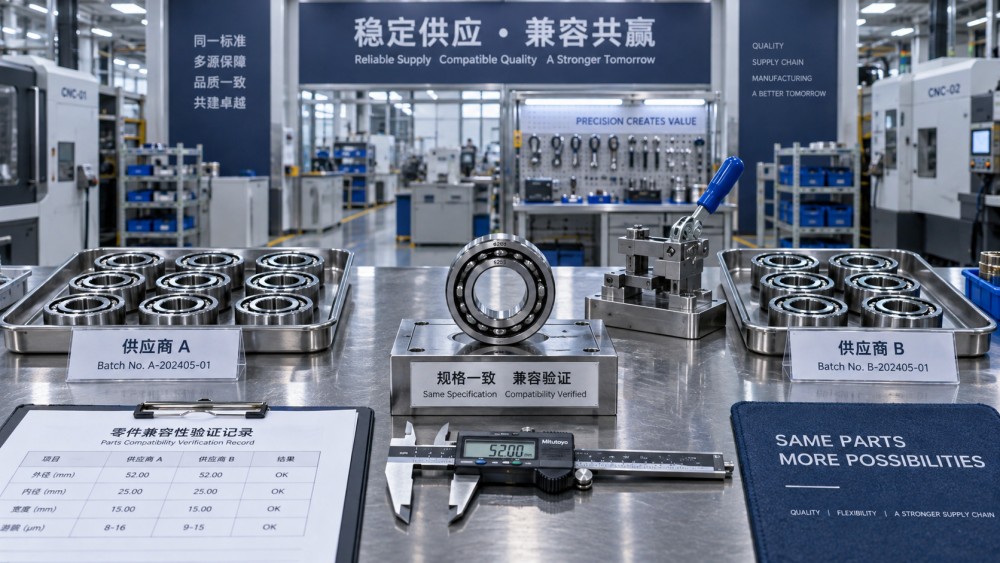
Matching dimensions do not establish interchangeability. Two industrial components can fit the same assembly while behaving differently under load, temperature, contamination, or repeated cycling. Those differences may affect efficiency, service life, noise, leakage, and maintenance intervals.
For precision bearings, relevant characteristics can include internal clearance, preload, running accuracy, lubrication, seals, and cage design. Power transmission parts may require attention to tooth geometry, hardness, surface treatment, and fatigue behavior. For hydraulic valves, matching ports and pressure ratings leaves questions about leakage, response, pressure drop, and compatibility with the operating fluid.
A useful qualification specification connects these characteristics to operating conditions. It should explain the loads, speeds, temperatures, fluids, duty cycles, and installation constraints that matter. This gives both suppliers a common acceptance basis and reduces dependence on assumptions hidden inside a familiar part number.
The distinction between a direct substitute and a conditional alternative is particularly important. If the second component requires a different spacer, control setting, lubricant, or maintenance interval, those changes belong in the approved manufacturing and service instructions. They also affect switching time and cost.
Qualification should combine dimensional and material checks with functional testing appropriate to the failure consequences. A first article can establish conformity, while production samples help assess consistency. Where wear or fatigue determines suitability, initial fit and short functional checks may leave important questions unanswered.
For equipment governed by customer approvals or formal change controls, include those release requirements in the switching plan. A technically acceptable component cannot protect production while it remains blocked from use.
Check whether the suppliers share the same failure points
Two supplier names do not necessarily represent two independent sources. Separate distributors may obtain parts from the same manufacturer. Different manufacturers may rely on the same steel mill, casting facility, heat-treatment subcontractor, or specialist coating process.
Map the dependencies most likely to interrupt the component under review. Complete visibility into every supplier tier is rarely practical, so focus on constrained materials, difficult processes, and transport routes that would be hard to replace quickly.
- Manufacturing origin: Establish where the part is produced and which critical operations are outsourced.
- Material supply: Identify dependencies on particular grades, forms, or mills where availability is limited.
- Tooling and ownership: Determine whether production depends on shared tooling, a common parent company, or one manufacturing site.
- Transport and geography: Consider whether both routes face the same border, port, infrastructure, or regional disruption.
- Capacity constraints: Ask whether both suppliers compete for the same scarce upstream capacity during demand peaks.
The required independence depends on the risk. A second local supplier may protect against a factory outage while offering little protection against a regional power interruption. Different countries may reduce some geographic exposure but introduce longer transport times and additional inventory needs.
Sector intelligence can help identify where to investigate. GPCM’s coverage of special steel prices, trade quotas, and component technology trends provides context for material and supply-route decisions. Supplier-specific evidence is still needed to establish whether two proposed sources share the dependency that matters.
Compare the full cost with the disruption it can realistically prevent
The commercial case should include more than the difference between quoted prices. Splitting demand can reduce volume discounts, increase minimum-order pressure, create duplicate safety stock, and add freight or inspection costs. Engineering time and supplier development may dominate the initial investment for a complex component.
Separate one-time qualification expenditure from recurring costs. The first may include tooling, samples, testing, and documentation. Recurring costs include keeping approvals current, maintaining purchase activity, auditing changes, managing inventory, and investigating quality differences.
Compare that expenditure with plausible disruption scenarios. Relevant consequences include idle production, expedited freight, delayed equipment deliveries, rescheduling, and restart work. Use contribution lost or costs actually incurred where possible; treating every delayed sale as permanently lost revenue can overstate the benefit.
The comparison must also account for residual risk. A secondary supplier may cover only essential demand, take time to increase output, or experience the same upstream shortage. The business case should credit the disruption it can reasonably reduce.
When disruption probabilities are uncertain, test the decision across several credible scenarios. For example, compare a brief delivery delay, a prolonged plant outage, and a material shortage affecting both sources. A strategy that works only under an extreme assumption may be difficult to sustain commercially.
Choose how the second source will stay ready
Dual sourcing does not require an equal allocation. The purchasing arrangement should reflect the capacity needed during a disruption, the volume required to keep the supplier engaged, and the cost of placing routine orders.
An ongoing volume split suits components with sufficient demand to support two production relationships. Regular orders reveal quality and delivery performance and help maintain familiarity with the specification. Allocation should leave both suppliers with commercially workable volumes; a token order may not support meaningful readiness.
A primary supplier with an active backup can suit applications where most demand remains with one source. The backup receives enough work to maintain production knowledge and demonstrate conformity. Its response obligations and available capacity need explicit agreement.
A qualified source held in reserve may suit low-volume parts where continuous allocation would be expensive. This approach requires periodic confirmation that tooling, processes, materials, approvals, and production capability remain available. An old approval and a dormant vendor account provide limited evidence of current readiness.
Capacity deserves separate attention from qualification. A supplier may make an acceptable part while having no room to absorb extra demand. Discuss the quantity it can provide, the notice required, the ramp-up sequence, and whether capacity is committed or offered on a best-effort basis. These differences determine how much inventory must bridge the switch.
When another approach offers better protection
Dual sourcing can be difficult to justify for a rarely purchased custom component whose qualification cost is high and whose design changes frequently. Maintaining two sets of tooling and repeating validation may consume resources without producing a dependable alternative.
Buffer inventory can be effective when demand is predictable, storage is practical, and the component does not deteriorate quickly. Storage conditions matter: corrosion, elastomer aging, lubricant degradation, and packaging damage can make apparently available stock unusable.
Redesign may offer greater long-term value when supply risk comes from an unusually tight tolerance, proprietary interface, or scarce material. Changing the design requires engineering effort and validation, but it may open access to several capable manufacturers and simplify future substitutions.
Supplier development can also address a specific weakness, such as unreliable scheduling or dependence on one production cell. It is most useful when the primary supplier can remove that weakness. Adding a second supplier is less persuasive when both would inherit the same unresolved constraint.
Make the switching plan part of the sourcing decision
Before committing volume, document how production will move from one source to the other. Define the trigger for switching, who authorizes it, which stock can be used, what inspections apply, and how material remains traceable through manufacturing and service.
Keep supplier-specific part identification even when components are approved as interchangeable. If a quality issue emerges, traceability allows affected batches to be isolated and performance differences to be investigated. Where assembly changes are required, make the associated instructions available before the first emergency order.
A practical decision record should answer five questions:
- What interruption is the second source expected to protect against?
- How long can usable stock support production under the relevant demand scenario?
- What evidence establishes technical acceptance and production consistency?
- Which shared dependencies remain, and what capacity is available during a switch?
- What annual cost and internal work are required to preserve readiness?
Review that record when demand, design, manufacturing location, or upstream supply changes. A backup that was adequate for a smaller production program may no longer cover essential demand, while a standardized replacement may make an expensive sourcing arrangement unnecessary.
Approve dual sourcing when the second supplier provides a technically usable, sufficiently independent route to the capacity you need within the time available. If that route cannot yet be demonstrated, the next action is to close the qualification, dependency, or capacity gap before relying on it to protect production.
Related News
- How to check data accuracy before choosing a supplier discovery toolOct 21, 2026Choosing a supplier discovery tool? Learn how to verify supplier data, certifications, and technical claims to reduce sourcing risks and build a shortlist you can trust.
- Can distributors profit from low-volume private label components?Oct 20, 2026Explore private label component solutions for distributors to turn low-volume demand into profit. Learn how to control costs, qualify suppliers, and launch a range with confidence.
- How to control design changes when working with an OEM supplierOct 18, 2026Working with an OEM cooperation supplier? Learn how to control design changes, align approvals, verify revisions, and prevent costly production errors with a practical change-control workflow.
- How to vet North American fluid dynamics engineering firms for CFDOct 13, 2026Searching for fluid dynamics engineering North America? Discover how to vet CFD firms, assess validation, and choose a partner for confident design decisions.
Related News
- 00
0000-00
How multi-axis motion control systems synchronize gantry axes - 00
0000-00
How to check data accuracy before choosing a supplier discovery tool - 00
0000-00
Can distributors profit from low-volume private label components? - 00
0000-00
Can fluid power systems for robotics deliver precise motion control? - 00
0000-00
How to control design changes when working with an OEM supplier
Dr. Alistair Vaughn
Strategic Intelligence Center