








How is regional sourcing changing industrial component supply chains?
Regional sourcing is reshaping industrial component supply chains as manufacturers weigh shorter lead times and supply resilience against cost, capacity, and technical qualification requirements. For business leaders, these component sourcing trends raise a critical question: when does proximity create measurable value, and when does it introduce new dependencies? From precision bearings and power transmission assemblies to hydraulic valve blocks, sourcing decisions must account for material availability, tolerance consistency, and supplier expertise—not geography alone.
The practical shift is not simply from overseas suppliers to local ones. It is toward supply networks that place production, inventory, technical support, and qualified backup capacity closer to demand. Those activities may sit in different locations. Understanding which one needs to move is more useful than treating regionalization as an all-or-nothing strategy.
Regionalization changes the network, not necessarily the component’s origin
Regional sourcing can mean purchasing from a nearby manufacturer, shifting final machining into the customer’s region, or using a regional distributor that stocks globally manufactured parts. Each arrangement changes a different exposure. Local inventory can shorten replenishment time without changing manufacturing dependence. Regional machining can improve engineering coordination while leaving the buyer exposed to imported forgings, specialty steel, seals, or rolling elements.
This distinction matters because a supplier’s shipping address says little about its upstream resilience. Two nearby bearing suppliers may rely on the same overseas ring producer. Two hydraulic assembly businesses may purchase identical cartridges from one source. A purchasing team can appear diversified while retaining a single point of failure.
A useful supply map therefore follows the component beyond final assembly: material production, heat treatment, precision finishing, surface treatment, inspection, and shipping. The objective is not complete local self-sufficiency. It is to identify which dependencies could interrupt production and whether the proposed regional arrangement actually changes them.
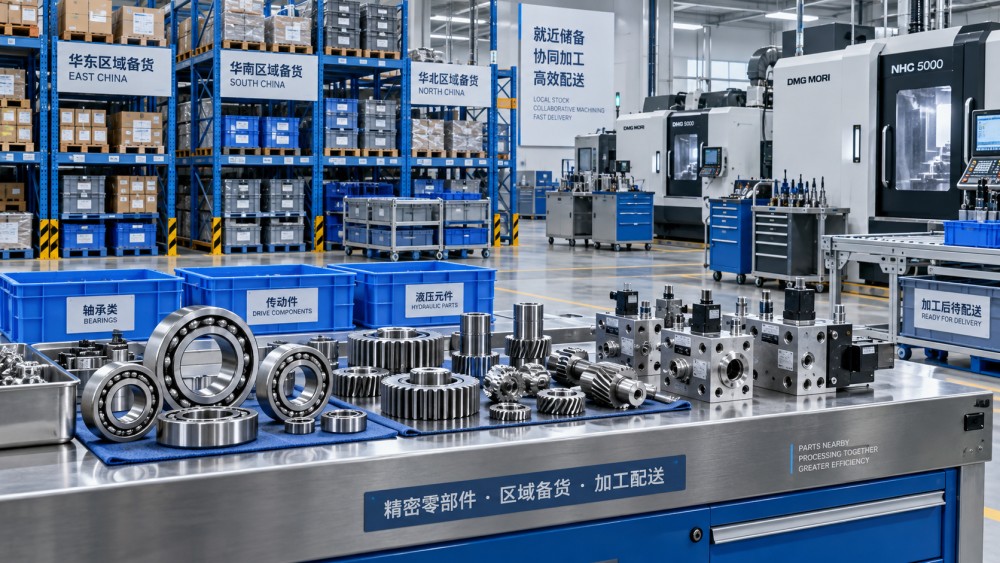
Why proximity is gaining weight in sourcing decisions
Long-distance sourcing remains economically attractive for many standardized components, especially where established suppliers combine scale with mature process control. Regional alternatives become more compelling when transit uncertainty, engineering changes, or small production batches make that model harder to manage.
Consider a machine builder adjusting a shaft-and-bearing arrangement during commissioning. The commercial value of a nearby supplier may lie less in freight savings than in faster inspection, easier failure analysis, and shorter feedback loops between design and production. For replacement chains or hydraulic service parts, availability during an unplanned shutdown may matter more than the original purchase price.
These advantages are conditional. A nearby factory with a long queue, limited grinding capacity, or outsourced heat treatment may be slower than an established international supplier holding regional stock. Buyers need to distinguish transit time from total replenishment lead time, including order release, material procurement, production scheduling, inspection, and delivery.
Trade measures add another consideration, but there is no universal policy advantage to buying regionally. Tariff treatment, rules of origin, and documentation obligations depend on the product and jurisdictions involved. Local invoicing or final assembly should not be assumed to establish preferential origin.
Precision components make supplier substitution harder
Regional supply networks cannot be assessed as though every component were interchangeable. A dimensionally compatible part may still behave differently under load, temperature, contamination, or repeated duty cycles. The closer a component sits to the machine’s performance limits, the more qualification matters.
Bearings and power transmission components
For precision bearings, matching the envelope dimensions is only a starting point. Internal clearance or preload, raceway finish, material condition, lubrication, sealing, and installation fits can affect operating behavior. An alternative source needs evidence against the application’s actual requirements, not merely a matching catalog designation.
Chains, gears, and couplings raise related questions. Heat treatment consistency, tooth geometry, alignment tolerance, fatigue performance, and lubrication requirements may determine whether a substitute is acceptable. A maintenance-free chain, for example, still needs evaluation against load, speed, temperature, and environmental conditions. The description alone does not establish equivalent service life.
Hydraulic components and integrated valve blocks
With hydraulic valve blocks, the qualification burden extends beyond external dimensions and nominal pressure. Internal passage geometry, burr removal, cleanliness, seal compatibility, leakage, and pressure-drop behavior can influence reliability and control performance. Moving machining closer to assembly helps only if those process requirements remain controlled.
Supplier approval should therefore cover production-representative parts and relevant operating conditions. Where applications involve safety functions or regulated equipment, validation and documentation requirements must be confirmed against the applicable standards and project specifications. Geography is not a substitute for technical evidence.
The cost comparison is moving beyond the quoted price
A regional supplier can quote a higher unit price and still offer a lower total cost. Equally, a shorter shipping route can fail to justify expensive tooling, qualification, or underutilized capacity. The comparison needs a common scope and a realistic purchasing horizon.
Relevant costs include freight, duties, inventory financing, inspection, nonconformance handling, engineering support, and supplier-change validation. Production interruption exposure also deserves attention, but it should be evaluated through explicit scenarios rather than presented as a guaranteed saving. Avoid counting the same benefit twice—for example, treating reduced inventory and reduced working capital as unrelated gains.
- For stable, high-volume demand: compare process capability, capacity, landed cost, and delivery consistency across a representative ordering cycle.
- For frequently revised components: include change implementation time, obsolete stock exposure, and the cost of engineering coordination.
- For production-critical spares: evaluate recovery time, stock ownership, interchangeability, and whether availability commitments are contractually supported.
Payment terms and order quantities can change the result substantially. Buying nearby does not automatically release cash if the supplier requires large minimum batches or advance payment. Conversely, a regional stocking agreement may improve responsiveness without requiring a manufacturing transfer.
Regional networks introduce their own concentration risks
Clustering suppliers near a production site simplifies coordination, but it can concentrate exposure to shared infrastructure, labor shortages, energy disruption, or extreme weather. Supplier count alone is therefore a weak measure of resilience. Independence matters more.
Capacity is another constraint. A regional supplier may produce excellent samples yet lack enough qualified equipment or skilled operators to sustain the required output. Buyers should ask which operations form the bottleneck, how capacity is allocated, and which subcontractors handle critical processes. These questions are especially important when multiple customers are attempting to regionalize simultaneously.
Dual sourcing also requires more than approving a second vendor. Backup tooling must remain usable, specifications must stay synchronized, and the alternative supplier needs a workable production relationship. An approved source that has received no orders for years may not be able to respond quickly when called upon.
For many manufacturers, a mixed network is the more credible option: regional supply for responsive production and service, supported by geographically separate sources for selected critical components. The right balance depends on application risk and the cost of maintaining genuine alternatives.
What these component sourcing trends mean for market intelligence
As sourcing becomes more regional, procurement intelligence needs to become more technical. Country-level cost comparisons cannot explain whether a local manufacturing cluster can repeatedly hold the required tolerances, secure suitable materials, or support demanding fluid-control applications.
The Global Precision Components & Motion Matrix (GPCM) addresses this intersection through its focus on industrial core components, power transmission, and fluid control technologies. Its Strategic Intelligence Center brings together tribology, fluid dynamics, and industrial economics perspectives to connect market developments with component-level decisions.
That connection is useful when interpreting special steel price movements, trade quota changes, or developments in composite bearings and integrated hydraulic valve blocks. A material-price signal is not automatically a reason to switch suppliers; it is a prompt to investigate material availability, quotation assumptions, and exposure across approved sources.
GPCM’s sector news, evolutionary trend analysis, and commercial insights can help frame those investigations. They complement rather than replace supplier audits, drawing reviews, and application testing. Standardization, low-friction design, and material recyclability also belong in the assessment where they affect operating cost or future substitution—not as automatic benefits of local production.
Start with the bottleneck, not a relocation target
A practical regional sourcing program begins with a small set of components whose supply failures would materially affect production. Map their upstream dependencies, separate transport delays from manufacturing delays, and establish the technical acceptance criteria before requesting alternative quotations.
Then decide what actually needs to change. The answer might be regional safety stock, a second finishing source, local service capability, or a fully qualified manufacturing alternative. Each addresses a different problem and carries a different implementation burden.
Before scaling a transfer, compare production-representative quality, delivered lead-time variation, engineering response, and total cost against the existing arrangement. Keep the incumbent source available until the replacement demonstrates repeatable performance. Regional sourcing creates measurable value when it removes a verified constraint without weakening component reliability—not simply when the supplier is closer.
- precision components
- industrial core components
- hydraulic valve blocks
- commercial insights
- power transmission components
- precision bearings
- composite bearings
- integrated hydraulic valve blocks
- power transmission assemblies
- fluid control technologies
- hydraulic components
- heat treatment
- component supply chains
- power transmission
- fluid control
- bearings
- gears
- tribology
- fluid dynamics
- special steel
Related News
- How to check data accuracy before choosing a supplier discovery toolOct 21, 2026Choosing a supplier discovery tool? Learn how to verify supplier data, certifications, and technical claims to reduce sourcing risks and build a shortlist you can trust.
- Can distributors profit from low-volume private label components?Oct 20, 2026Explore private label component solutions for distributors to turn low-volume demand into profit. Learn how to control costs, qualify suppliers, and launch a range with confidence.
- How to control design changes when working with an OEM supplierOct 18, 2026Working with an OEM cooperation supplier? Learn how to control design changes, align approvals, verify revisions, and prevent costly production errors with a practical change-control workflow.
- How to vet North American fluid dynamics engineering firms for CFDOct 13, 2026Searching for fluid dynamics engineering North America? Discover how to vet CFD firms, assess validation, and choose a partner for confident design decisions.
Related News
- 00
0000-00
How to check data accuracy before choosing a supplier discovery tool - 00
0000-00
Can distributors profit from low-volume private label components? - 00
0000-00
Can fluid power systems for robotics deliver precise motion control? - 00
0000-00
How to control design changes when working with an OEM supplier - 00
0000-00
When do precision ground gears reduce noise in high-speed gearboxes?
Dr. Alistair Vaughn
Strategic Intelligence Center