








Is a Higher Actuator IP Rating Necessary for Factory Environments?
Is a higher actuator IP rating necessary for factory environments? Often, but not automatically. The right answer depends on how an actuator is exposed during real operation—not simply on the fact that it is installed inside a factory. A dry automated assembly line, a grinding cell, a food-processing washdown area, and an outdoor loading station may all use linear or rotary actuators, yet their ingress protection requirements can be very different.
Choosing too low an IP rating can lead to moisture-related faults, abrasive contamination, connector corrosion, premature seal wear, or unplanned stoppages. Choosing the highest available rating everywhere can also be wasteful. It may increase component cost, restrict cooling, complicate cable routing, or create a false sense of security when the true weak point is a connector, mounting interface, or damaged cable gland.
For maintenance managers, machine builders, and purchasing teams, the useful question is therefore not “What is the highest IP rating?” It is: “What level of protection matches the actuator’s actual exposure throughout its service life?”
An IP rating is a boundary condition, not a durability guarantee
Ingress protection ratings are commonly defined through IEC 60529. The first digit addresses protection against access to hazardous parts and solid foreign objects, including dust. The second digit addresses water ingress. An enclosure marked IP65, for example, is intended to be dust-tight and protected against water jets. IP67 adds protection for temporary immersion under specified test conditions.
Those definitions matter, but they do not describe every condition an actuator will face. They do not automatically confirm resistance to cutting fluid, caustic detergents, salt-laden air, high-temperature spray, vacuum effects, repeated thermal cycling, vibration, or pressure washing at close range. Nor do they prove that an actuator will maintain the same protection after years of motion, seal compression, cable flexing, and maintenance access.
This distinction is especially important with electromechanical actuators. The housing may have a strong enclosure rating, while a poorly selected mating connector, an open service port, a cracked conduit fitting, or an incorrectly installed cable entry creates a direct path for contamination. In pneumatic and hydraulic systems, breather arrangements, rod seals, valve connectors, and hose terminations deserve the same scrutiny.
A higher rating is valuable when it addresses a known exposure. It is less useful when it is used as a shorthand for “industrial-grade.”
Start with the factory zone, not the actuator catalogue
Factories are rarely uniform environments. One production line can contain clean assembly stations, abrasive machining operations, coolant mist, fork-truck traffic, washdown procedures, and temperature-controlled cabinets. A practical assessment begins by mapping the actuator’s local exposure rather than assigning one blanket requirement to the entire facility.
On a clean, enclosed assembly machine, an actuator may only encounter occasional airborne dust and routine wipe-down. Here, a moderate enclosure rating may be entirely appropriate, provided the wiring and connector system match it. In contrast, a metalworking cell may expose the actuator to fine conductive particles, abrasive swarf, coolant aerosol, and intermittent direct spray. Dust exclusion and seal compatibility can matter more than protection against temporary immersion.
Washdown applications require more care still. The direction, distance, pressure, temperature, frequency, and chemistry of cleaning all influence the selection. A unit that tolerates occasional low-pressure spray is not necessarily suitable for repeated close-range cleaning. Food, beverage, pharmaceutical, and chemical-processing equipment may also require attention to cleanability, corrosion resistance, lubricant containment, and material compatibility beyond the IP code itself.
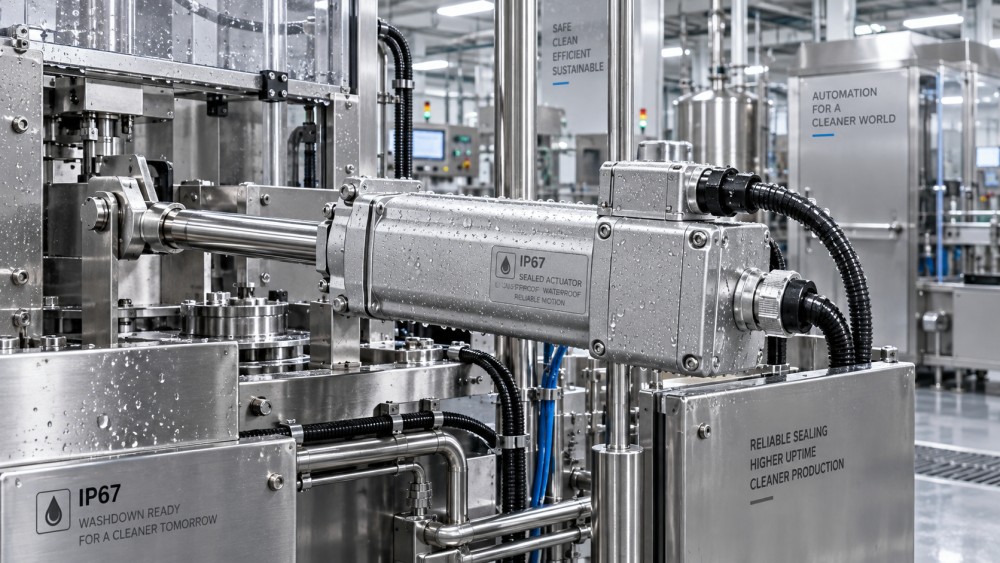
Outdoor factory interfaces create another category. Dock doors, bulk-material systems, wastewater equipment, and external transfer stations can experience rain, condensation, ultraviolet exposure, temperature swings, and wind-driven contaminants. An actuator located beneath a protective hood may face a very different risk profile from one mounted in an exposed orientation where water can pool around a cable entry or rod seal.
Where higher protection is usually justified
A higher actuator IP rating is generally easier to justify where contamination is routine, direct, and difficult to control. That includes applications with persistent fine dust, frequent washdown, outdoor weather exposure, splash zones, or equipment located near coolant and process-fluid discharge points. It may also be sensible where the actuator is hard to access and a failure would interrupt a critical machine sequence.
The expected failure mode should guide the decision. Fine powder can migrate through gaps that might not be a concern in a conventional assembly area. Metal fines can be especially problematic near sensors, brakes, and electrical interfaces. Moisture that enters an enclosure may not cause an immediate fault, but corrosion can develop gradually at terminals, encoder circuits, or connector contacts. Repeated contamination often produces the expensive kind of downtime: intermittent faults that are difficult to reproduce.
Protection can also be justified by the consequences of a stop. An actuator driving a non-critical reject gate may be quickly replaceable. One controlling a safety-related guard, a process valve, or a synchronized handling axis may require a more conservative environmental design. That decision should still be based on the complete system architecture, including redundant safeguards where relevant, rather than on IP rating alone.
When “more IP” can be the wrong purchasing shortcut
Specifying the highest available rating across every actuator can mask a poorly defined requirement. It may direct budget toward sealed housings while leaving unprotected connectors, exposed couplings, unshielded sensor cables, or unsuitable mounting geometry unchanged. The result is a more expensive actuator in a system that remains vulnerable.
There can also be engineering trade-offs. Sealing strategies influence heat dissipation, service access, weight, and the design of moving interfaces. For electrically driven equipment, thermal performance deserves review when duty cycles are high. For cylinders and rod-style actuators, a protective bellows or rod cover may reduce contamination at the moving interface, but it must be selected and installed so that it does not trap debris, restrict travel, or create a maintenance burden of its own.
It is also unwise to treat IP67 as universally “better” than IP65 for a washdown line. Temporary immersion and water-jet exposure are separate test conditions. The proper requirement depends on the actual cleaning method and installation geometry. If a specification calls for a particular protection level, the purchaser should verify exactly what the manufacturer declares for the complete actuator configuration, including any connector or cable assembly supplied with it.
The overlooked details that decide whether protection holds up
The actuator enclosure is only one layer of defence. In factory installations, many ingress failures begin at interfaces. Cable entries should have the correct diameter range, sealing method, tightening practice, and orientation. Unused ports need properly rated plugs. Mating connectors must be fully engaged, and their rated protection may depend on being mated rather than left open during service.
Mounting position matters more than is sometimes assumed. A cable gland facing upward, a horizontal ledge where wash water collects, or a rod pointing into a stream of abrasive debris can undermine a sound component choice. Simple shields, drip loops, guards, or relocation of the actuator outside the direct process zone may deliver better reliability than a more aggressive IP specification alone.
Chemical compatibility requires separate review. Oils, coolants, cleaning agents, disinfectants, solvents, and process vapours can affect elastomers, coatings, plastics, labels, and cable jackets. An IP test does not establish compatibility with every cleaning formulation. Where chemical exposure is relevant, material declarations and application guidance from the actuator supplier should be checked against the actual media and cleaning routine.
Maintenance practices complete the picture. A high rating can be compromised when covers are repeatedly removed, seals are reused after damage, cable glands are replaced with unverified parts, or cleaning staff direct a spray stream into locations never intended for direct exposure. Environmental protection needs to be considered in work instructions, inspection routines, and spare-parts control—not only in the original bill of materials.
A more useful specification process
Instead of writing “high IP rating required,” define the exposure in operational terms. Ask whether the actuator sees settled dust, airborne powder, coolant mist, direct jetting, intermittent splash, condensation, or possible submersion. Record how frequently this occurs, where it strikes the equipment, and whether the source contains abrasive or corrosive material. Distinguish normal production exposure from cleaning, fault conditions, and shutdown periods.
Then review the actuator as an installed assembly. The following questions usually uncover more than a rating comparison alone:
- What IP rating is declared for the actuator, and under what configuration?
- Are the cable, connector, gland, sensor interface, and control enclosure protected to a compatible level?
- Will process fluids or detergents contact seals, coatings, cable jackets, or moving rods?
- Can water drain freely, or are there pockets where liquid and debris accumulate?
- Does the duty cycle create heat that could be affected by a more enclosed design?
- What happens if protection degrades: a controlled stop, a quality issue, or a difficult-to-diagnose intermittent failure?
This is where cross-disciplinary review is useful. Mechanical engineers may focus on mounting and debris paths; electrical teams may identify connector and cable risks; maintenance staff often know how equipment is actually cleaned. At GPCM, technical intelligence around precision motion, fluid control, materials, and power transmission is most valuable when these perspectives are connected. An actuator rating becomes a better procurement decision when it is read alongside tribology, sealing materials, environmental exposure, and lifecycle maintenance realities.
The practical answer
A higher actuator IP rating is necessary when the factory environment exposes the equipment to dust, water, fluids, or weather conditions that the lower-rated design cannot reliably tolerate. It is not necessary merely because the word “factory” appears in the application description. Clean automation cells, protected control cabinets, and well-guarded machinery may not benefit from maximum ingress protection, while washdown, machining, powder handling, and outdoor installations often demand a more deliberate approach.
The strongest selection is rarely the highest number on a datasheet. It is the rating and installation design that match the real contaminant, the real cleaning method, the real interface details, and the cost of interruption. Before approving an actuator, confirm the declared IP condition, cable and connector arrangement, material compatibility, mounting orientation, and maintenance plan. Those checks turn ingress protection from a catalogue filter into a credible reliability decision.
Related News
- Is a Higher Actuator IP Rating Necessary for Factory Environments?Oct 11, 2026Is a higher actuator IP rating necessary for factory environments? Learn how to match protection levels to dust, washdown, fluids, and downtime risks.
- When stainless steel industrial couplings are needed for corrosive fluidsOct 08, 2026Stainless steel industrial couplings for corrosive fluids: compare alloys, seals, pressure ratings, and low-spill designs for safer, longer-lasting connections.
- How to size high pressure industrial valves for pressure spikesSep 16, 2026High pressure industrial valves for pressure spikes: learn how to assess transient peaks, relief capacity, response speed, and fatigue life for safer system performance.
- How application engineering for fluid control reduces valve sizing riskSep 15, 2026Application engineering for fluid control reduces valve sizing risk by evaluating duty cycles, pressure drop, cavitation, control stability, and shutoff performance.
Related News
- 00
0000-00
When do tighter tolerances justify precision manufacturing solutions for aluminum parts? - 00
0000-00
Power Transmission Component Casting Defects That Shorten Gearbox Service Life - 00
0000-00
Is a Higher Actuator IP Rating Necessary for Factory Environments? - 00
0000-00
How to build a product category guide for Latin American markets - 00
0000-00
When stainless steel industrial couplings are needed for corrosive fluids
Fluid Dynamics Fellow
Strategic Intelligence Center