





In precision engineering, tolerance gaps rarely start on the shop floor alone—they often emerge earlier in design assumptions, material behavior, process capability, and supplier interpretation. For technical evaluators, understanding where these deviations begin is essential to preventing performance loss, assembly issues, and lifecycle risk. This article explores the root causes behind tolerance variation and how better technical intelligence can support more reliable component decisions.
Why scenario differences matter before any precision engineering review begins
A tolerance strategy that works in one application can fail quickly in another. In precision engineering, the same nominal dimension may be acceptable in a low-speed support bracket, but completely inadequate in a servo-driven actuator, a hydraulic valve spool, or a high-cycle bearing assembly. Technical evaluators therefore cannot assess tolerance gaps in isolation; they must ask where the component will operate, what loads it will carry, how it will be assembled, and how variation will accumulate across the system.
This is especially important in cross-border sourcing and multi-supplier manufacturing, where the drawing may look stable while the real interpretation differs by process route, inspection method, material batch behavior, or local standard practice. A tolerance deviation often begins when one party assumes “machinable,” another assumes “economical,” and a third assumes “functionally safe.” The result is a gap not only in microns, but in technical intent.
For evaluators working with motion components, transmission parts, or fluid control hardware, the practical question is not simply whether a tolerance is tight or loose. The better question is whether the tolerance chain matches the application scenario. Precision engineering performs best when design logic, process capability, inspection criteria, and field conditions are aligned from the start.
Typical sources of early mismatch
- Design teams define nominal geometry without enough process capability feedback.
- Material selection changes thermal growth, hardness response, or finishing behavior.
- Suppliers interpret fit, surface, and datum requirements differently.
- Assembly conditions introduce stack-up effects not visible in single-part inspection.
- Application environments add vibration, pressure, contamination, or temperature drift.
What technical evaluators should confirm first
Before approving a part, confirm the function-driving dimensions, the actual operating window, the manufacturing route, and the inspection reference system. In precision engineering, many costly problems begin when stakeholders validate print compliance without validating application relevance.
Three high-impact application scenarios where tolerance gaps usually begin
Although precision engineering affects nearly every industrial sector, tolerance problems tend to surface earliest in applications where motion transfer, sealing stability, and repeatable positioning are critical. These scenarios deserve different evaluation methods because the risk is not the same even when dimensions appear comparable on paper.
For technical evaluators, the value of scenario-based review is speed and clarity. It helps identify which dimensions are merely inspected and which dimensions truly govern system behavior. The following scenarios reflect common decision environments across automated machinery, power transmission assemblies, and fluid control systems.
Instead of asking whether the supplier can make a part “to tolerance,” ask whether the supplier can consistently hold the tolerances that matter under the application conditions that matter.
Scenario 1: Automated motion systems and positioning assemblies
Linear guides, couplings, shafts, housings, and encoder-related interfaces often fail not because one feature is out of specification, but because several small deviations combine into positioning error, vibration, backlash, or premature wear. In this precision engineering scenario, geometric relationships usually matter more than simple size control.
Technical evaluators should pay close attention to datum strategy, coaxiality, flatness, perpendicularity, and fit consistency after heat treatment or coating. A shaft-ground surface that passes size inspection but shifts due to residual stress can still destabilize motion accuracy in service.
The risk increases when components are sourced separately and assembled later by an OEM or integrator. Precision engineering gaps in these cases often begin with unshared assumptions about bearing preload, coupling stiffness, or thermal operating range.
Scenario 2: Power transmission and rotating component interfaces
Chains, sprockets, gears, bushings, and bearing seats are highly sensitive to cumulative variation. Here, a tolerance gap may begin in tooth geometry, seat finish, lubrication pathway design, or hardness distortion after treatment. The issue is not always visible at incoming inspection because real failure appears under load cycles.
In these applications, precision engineering must account for running clearance, friction behavior, contact pattern, and wear progression. Evaluators should question whether tolerances were set from functional load models or copied from legacy drawings built for different speeds and duty cycles.
This scenario also requires stronger supplier process evidence. A part can be dimensionally compliant yet dynamically unstable if tool wear control, grinding consistency, or batch-level hardness variation is poorly managed.
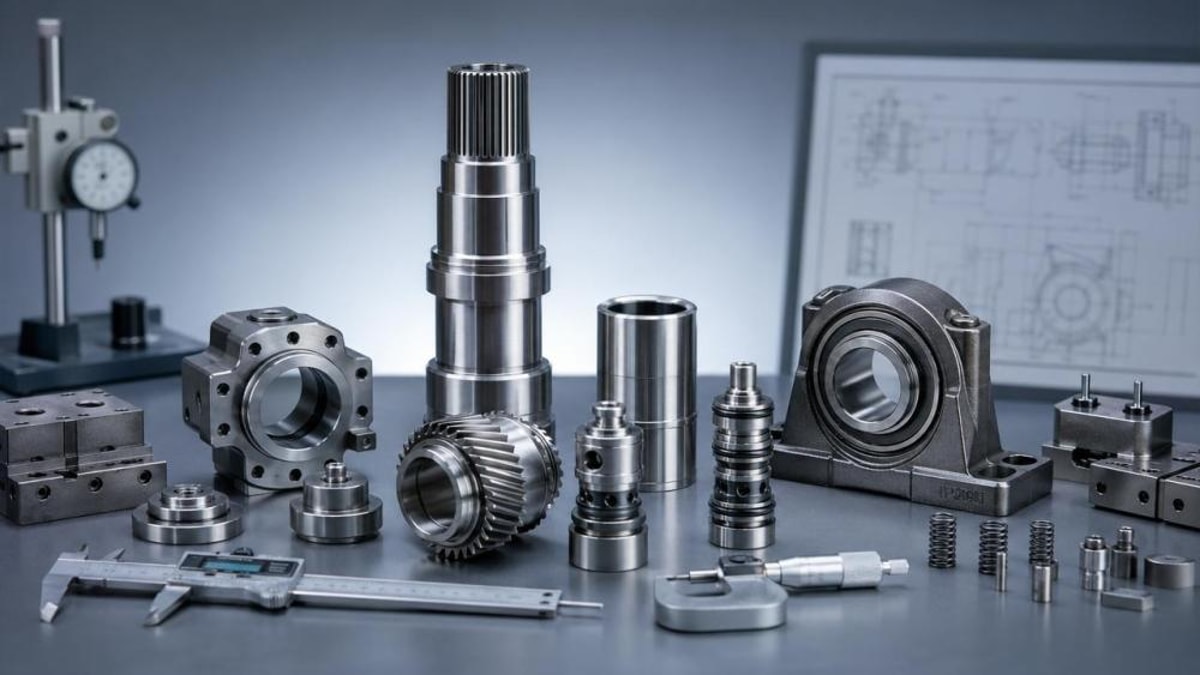
Scenario 3: Hydraulic and fluid control components
Valve bodies, spools, sleeves, seals, and pump interfaces often expose the most unforgiving tolerance gaps in precision engineering. Small deviations influence leakage, pressure fluctuation, response delay, sticking, and contamination sensitivity. Unlike structural parts, these components often fail functionally long before they fail visibly.
Technical evaluators should look beyond linear dimensions and focus on surface integrity, roundness, edge condition, internal passage consistency, and assembly cleanliness limits. A bore and spool may individually pass inspection, yet still create unstable performance because of surface pairing behavior or thermal expansion mismatch.
This is where engineering intelligence becomes critical. Precision engineering decisions in fluid control must be tied to pressure class, medium characteristics, duty frequency, and contamination exposure. A tolerance suitable for general hydraulic service may be risky in high-response servo-hydraulic use.
How requirements shift across scenarios: a comparison for technical evaluators
The same keyword—precision engineering—covers very different evaluation priorities depending on the operating context. Technical assessment becomes more reliable when reviewers compare scenarios side by side instead of applying one uniform checklist to every part family.
The table below summarizes where tolerance gaps usually begin, what they affect, and what evidence evaluators should request. It is designed for practical use in supplier review, drawing validation, and component qualification.
This comparison also supports sourcing decisions, especially when buyers must balance technical risk, delivery pressure, and cost targets.
A useful evaluation principle
In precision engineering, tighter is not automatically better. Overly aggressive tolerances can increase scrap, cost, lead time, and supplier stress without improving functional performance. The better target is functional sufficiency supported by proven process capability.
Common misjudgments that create hidden tolerance risk
Many tolerance failures are rooted in review habits rather than manufacturing weakness. Technical evaluators often inherit drawings, qualification standards, or supplier assumptions that were reasonable in earlier programs but no longer fit current duty conditions. Precision engineering breaks down when legacy logic is treated as universal truth.
The most common misjudgment is to treat dimensional compliance as complete compliance. A part can pass incoming inspection and still fail because of burr behavior, microgeometry, coating buildup, or thermal movement in operation. Another frequent issue is to rely on a single first-article result instead of evaluating process stability over batches.
In supplier transitions, a dangerous assumption is that two manufacturers using the same material grade and drawing will achieve the same functional precision. In reality, machine platform rigidity, fixturing strategy, tooling wear management, metrology discipline, and interpretation of standards can differ significantly.
Frequent review gaps by scenario
- Motion systems: ignoring stack-up behavior after full assembly.
- Transmission parts: approving dimensions without checking distortion after treatment.
- Fluid control components: underestimating surface interaction and cleanliness limits.
- Multi-supplier programs: assuming all parties use the same datum and fit interpretation.
- Cost-down projects: loosening tolerances without updating functional risk analysis.
When to be especially cautious
Use extra caution when the application involves high cycle life, pressure sensitivity, sealed interfaces, autonomous operation, or difficult maintenance access. In these cases, a small precision engineering error can propagate into warranty exposure, downtime, or safety-related consequences.
A scenario-based evaluation framework for more reliable precision engineering decisions
To reduce uncertainty, technical evaluators need a repeatable framework that links drawing review to application performance. This is where a structured intelligence approach—like the one emphasized by GPCM—adds practical value. By connecting material science, tribology, fluid dynamics, and supplier capability signals, evaluators can identify where tolerance gaps are likely to originate before they become production defects.
A good review process should begin with the operating scenario, then move to functional dimensions, process route, inspection method, and batch stability evidence. This sequence helps prevent the classic mistake of approving a component because it looks precise rather than because it behaves reliably in context.
For organizations comparing suppliers, this framework also improves communication. It replaces vague requests for “better precision” with specific, scenario-relevant requirements.
Recommended evaluation steps
- Define the real application window: load, speed, pressure, temperature, and service life.
- Identify function-critical dimensions and geometric relationships.
- Map likely variation sources: material, machining, heat treatment, coating, assembly.
- Request process capability and metrology evidence, not only sample reports.
- Validate performance with scenario-relevant testing where risk is high.
Questions worth asking suppliers
Ask how the supplier controls distortion, which dimensions are monitored in process, how gauge correlation is maintained, and which features show the highest batch variation. In precision engineering, these answers often reveal more than a polished inspection sheet.
Practical conclusion: match tolerance decisions to the application, not the drawing alone
Where do precision engineering tolerance gaps usually begin? In many cases, they begin when application context is separated from design intent, or when supplier capability is judged without enough functional evidence. The earlier these disconnects are recognized, the lower the risk of assembly issues, field instability, and avoidable lifecycle cost.
For technical evaluators, the most effective approach is scenario-based judgment. Motion systems require alignment discipline, transmission assemblies demand load-aware fit control, and fluid components depend on surface and leakage behavior that ordinary dimensional checks may miss. Precision engineering succeeds when tolerances are interpreted as part of a working system rather than as isolated numbers.
If your team is reviewing new suppliers, redesigning a critical component, or validating high-precision parts across global sources, start by defining the operating scenario and the real failure mode. Then align tolerances, material assumptions, process capability, and inspection strategy around that reality. That is the path to more dependable precision engineering decisions—and to stronger technical credibility across the industrial value chain.
Related News
- When precision manufacturing quality looks stable but is notApr 30, 2026Precision manufacturing may look stable while hidden variation grows. Learn how to spot false quality signals, reduce risk, and make smarter sourcing and reliability decisions.
- Where precision engineering tolerance gaps usually beginApr 30, 2026Precision engineering tolerance gaps often begin before machining—learn the hidden causes across design, materials, suppliers, and application scenarios to reduce risk and improve component reliability.
Related News
- 00
0000-00
Industrial Automation Components Supplier: Key Compliance Checks Before Scaling Orders - 00
0000-00
How to Shortlist a Precision Engineering Supplier for Repeatable Quality - 00
0000-00
Evolutionary Trends in Precision Engineering: What Is Changing in Supplier Capabilities - 00
0000-00
When Precision Manufacturing OEM Makes Sense Over In-House Production - 00
0000-00
Hydraulic Valve Blocks for Precision Engineering: What Affects Service Life Most
Optical Mech Engineer
Strategic Intelligence Center