





Delays in precision component manufacturing rarely stem from a single issue. For project managers and engineering leads, they often result from tolerance complexity, material availability, tooling bottlenecks, supplier coordination gaps, and quality validation cycles. Understanding these hidden causes is essential for protecting delivery schedules, controlling costs, and improving supply chain resilience in high-precision industrial projects.
Why does precision component manufacturing get delayed even when the production plan looks realistic?
A realistic schedule on paper can still fail in practice because precision component manufacturing depends on a chain of tightly linked variables. A machining center may be available, but the required material batch may still be under certification. A supplier may confirm delivery, yet first-article approval may reveal dimensional drift that forces rework. For project managers, the core issue is that these delays are cumulative rather than isolated.
Unlike general fabrication, precision component manufacturing must satisfy narrow tolerances, surface finish standards, geometric dimensioning requirements, and often application-specific reliability targets. That means each step—material preparation, machining, heat treatment, coating, inspection, packing, and logistics—has less room for deviation. Even a small inconsistency can trigger a hold point.
Another reason schedules slip is that many lead time assumptions are built around standard capacity rather than constrained capacity. In reality, high-accuracy grinding, wire EDM, multi-axis milling, lapping, and metrology resources are usually limited. When several urgent orders compete for the same specialist process, queues form quickly.
What usually hides behind a “normal” lead time estimate?
Lead time estimates often reflect ideal sequencing, not the interruptions common in industrial supply chains. They may exclude engineering clarifications, sample validation, fixture adjustment, outsourced heat treatment turnaround, and document approval. In sectors that depend on critical industrial components, these hidden tasks are often where the schedule is truly won or lost.
- Drawing revisions after manufacturability review
- Material substitution checks caused by stock shortages
- Inspection delays due to overloaded CMM resources
- Packaging or export documentation gaps for international delivery
What should engineering leads ask first?
Before accepting a quoted schedule, ask whether the supplier has included process-specific waiting time, approval cycles, and contingency for nonconformance. In precision component manufacturing, optimistic planning is common, but resilient planning is what protects the project.
Which technical factors cause the most common delays in precision component manufacturing?
The most frequent technical causes are tolerance complexity, material behavior, process sensitivity, and inspection burden. These factors are often underestimated by buyers who focus mainly on nominal dimensions and unit price. However, the actual manufacturing challenge lies in the relationship between material, geometry, and process route.
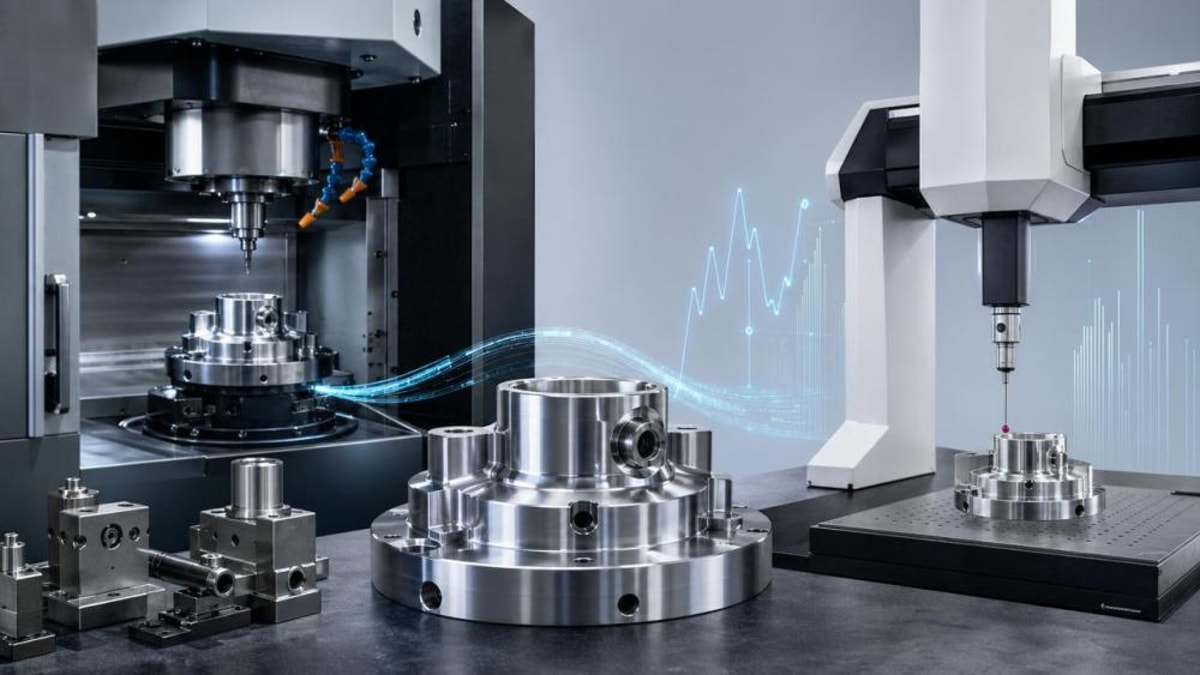
Tight tolerances increase setup time, in-process measurement frequency, and machine calibration requirements. Components with thin walls, deep cavities, concentricity requirements, or low runout targets are especially vulnerable to process variation. If the part also needs heat treatment, dimensional distortion can create a second round of machining or selective scrap.
Material selection can also slow production. High-hardness alloys, stainless steels, specialty bronzes, engineering ceramics, and advanced composites may require special tools, lower cutting speeds, or outsourced processing. If mill certificates, traceability records, or mechanical property verification are mandatory, procurement and release take longer as well.
How do complex tolerances create scheduling risk?
A part with multiple interacting tolerances is harder to machine than a part with a single tight dimension. For example, positional accuracy combined with flatness, perpendicularity, and surface roughness creates a stack of process controls. If one operation shifts the datum condition, later operations may no longer achieve final compliance. That forces additional inspection, process adjustment, or complete remanufacture.
This is why precision component manufacturing schedules should be linked to tolerance risk, not only to part count. Ten simple parts can move faster than one demanding component with complex GD&T and multiple finishing stages.
What technical issues are most likely to trigger rework?
How do supply chain and supplier coordination problems slow down delivery?
Many delivery failures in precision component manufacturing are not caused by machining alone. They begin upstream with raw material lead times, external processing queues, drawing clarification delays, or weak communication between the buyer, contract manufacturer, and sub-tier suppliers. For project leaders, supplier coordination is often the most practical lever for schedule control.
A common issue is fragmented ownership. One supplier sources material, another performs heat treatment, a third handles plating, and the final manufacturer is expected to integrate all steps. If no one owns timeline visibility across the full route, delays remain hidden until the promised ship date is close. By then, recovery options are limited and expensive.
Global sourcing adds another layer of uncertainty. Special steel allocation, export documentation, customs delays, and freight volatility can all affect the timeline. In industrial programs with strict commissioning windows, these factors can disrupt not only procurement but also assembly, testing, and customer acceptance.
What supplier signals suggest schedule risk early?
Buyers should not rely only on “on time” promises. Better indicators include response speed to technical questions, transparency around subcontracted processes, clarity on material traceability, and willingness to share milestone-level planning. Strong suppliers in precision component manufacturing can explain exactly where capacity is secure and where risk remains.
- No clear confirmation of raw material stock or booking
- Vague answers about heat treatment or coating partners
- Repeated requests for drawing clarification after PO release
- No milestone plan for first article, inspection, and shipment
Why do coordination gaps matter more for precision parts?
Because precision parts have less tolerance for substitution, process shortcuts, and undocumented changes. A late answer on a datum interpretation or material equivalency can stop manufacturing entirely. In lower-precision work, teams may absorb small ambiguities. In precision component manufacturing, ambiguity usually becomes delay.
Why do inspection, validation, and approval stages often become the hidden bottleneck?
Inspection is not merely a final check; it is part of the production system. In precision component manufacturing, every demanding feature increases the amount of measurement planning, fixture preparation, instrument verification, and reporting. If a production team finishes machining before the quality team is ready, parts simply wait in queue.
First article inspection can be especially disruptive when expectations are unclear. If the buyer wants full dimensional reports, capability evidence, material certificates, surface finish records, and process traceability, those requirements must be aligned before production begins. Otherwise, finished parts may need to be reopened, remeasured, or partially remade to meet documentation standards.
Validation delays also increase when acceptance criteria differ between engineering, quality, and procurement. One team may approve based on function, another on print compliance, and another on customer-specific protocol. Without a shared release rule, approved parts can remain blocked.
Which approval-stage mistakes are most common?
- Requesting full inspection reports without defining critical dimensions first
- Treating prototype approval rules the same as serial production rules
- Approving drawings late after tooling or fixtures are already prepared
- Escalating quality issues only after shipment readiness
How can teams shorten the validation cycle?
Project managers should define acceptance documents, sampling logic, and critical-to-quality features before manufacturing starts. For recurring precision component manufacturing programs, preapproved control plans, gauge strategies, and deviation workflows can save days or even weeks across multiple lots.
What are the most common planning mistakes buyers and project managers make?
One of the biggest mistakes is treating all suppliers as equally capable simply because they have similar machine lists. Precision component manufacturing performance depends not only on equipment, but also on process engineering, tool management, metrology discipline, documentation control, and subcontractor stability. Two shops with the same CNC platform can deliver very different outcomes.
Another common mistake is releasing production before the drawing package is truly stable. Last-minute updates to tolerances, materials, finishes, or inspection notes often create cascading delay. Even small print changes may invalidate tooling assumptions, inspection plans, or stock preparation.
Teams also underestimate buffer needs for first-time builds. New parts almost always require learning cycles. When the schedule assumes serial-production efficiency on an unproven component, delays should be expected rather than treated as exceptions.
What practical checks improve schedule realism?
Is low price itself a delay risk?
Often, yes. Extremely low pricing can mean overloaded capacity, low inspection coverage, unstable tooling strategy, or dependence on the cheapest available subcontractor. For critical precision component manufacturing, the lowest unit cost can create the highest schedule risk.
How can project managers reduce delays in precision component manufacturing before they happen?
The best prevention strategy is to manage the program at the intersection of engineering clarity, supplier visibility, and quality readiness. Delays become less likely when the manufacturing route is understood in detail before production starts and when all parties share the same priorities for critical features and milestone dates.
Start by segmenting parts according to risk. Components with difficult materials, complex tolerances, multi-stage finishing, or external validation should receive more review than standard items. A uniform planning method across all parts usually hides where attention is truly needed.
Next, insist on milestone-based communication rather than generic status updates. “In production” is not enough. Strong schedule control in precision component manufacturing comes from knowing whether the material is received, rough machining is done, heat treatment is complete, first article is passed, and final inspection is released.
What should a delay-prevention checklist include?
- Confirmed drawing revision and manufacturability review
- Verified raw material source, grade, and certification timeline
- Identified outsourced special processes and lead times
- Defined critical dimensions and inspection method
- Assigned owner for first article approval and deviation decisions
- Built schedule buffer for first-time or high-risk parts
How does market intelligence help reduce future disruption?
For organizations managing industrial supply chains, intelligence on material pricing, trade restrictions, process capacity shifts, and technology evolution helps teams anticipate pressure before it appears in supplier lead times. This is where platforms such as GPCM add strategic value: not only by tracking sector change, but by translating it into practical decisions for sourcing, engineering planning, and supplier development.
What questions should you clarify before sourcing or launching a new precision manufacturing project?
If you want to prevent surprises, the final step is disciplined pre-launch questioning. Precision component manufacturing rewards teams that clarify assumptions early. The goal is not to ask more questions for the sake of process, but to identify the few issues most likely to affect delivery, cost, and acceptance.
A practical review should cover three areas: technical feasibility, supply continuity, and release criteria. When these are aligned, schedule confidence improves substantially. When they are not, even experienced suppliers may miss deadlines despite good intentions.
If you need to confirm a specific sourcing plan, parameters, lead time, quotation path, or cooperation model, prioritize questions such as: Is the drawing fully manufacturable at the required tolerance? Which operations are internal versus outsourced? What is the true critical path? What approval documents are required for shipment? What contingency exists if material, tooling, or inspection capacity changes? These are the questions that turn precision component manufacturing from a scheduling risk into a controlled execution process.
Related News
- How to Shortlist a Precision Engineering Supplier for Repeatable QualityMay 05, 2026Precision engineering supplier selection starts with repeatable quality. Learn how to shortlist vendors by tolerances, inspection, materials, and supply reliability.
- Evolutionary Trends in Precision Engineering: What Is Changing in Supplier CapabilitiesMay 05, 2026Evolutionary trends in precision engineering are redefining supplier capabilities—from tighter tolerances to smarter quality systems. Discover how to assess technical credibility and sourcing resilience.
- When Precision Manufacturing OEM Makes Sense Over In-House ProductionMay 05, 2026Precision manufacturing OEM makes sense when in-house production adds hidden cost, quality risk, or delays. Learn when outsourcing improves precision, speed, and project results.
- How to Compare a Precision Machining Manufacturer Without Missing Critical TolerancesMay 05, 2026Precision machining manufacturer comparison starts with critical tolerances, process control, and inspection proof. Learn how to reduce quality risk and choose a supplier with confidence.
Related News
- 00
0000-00
Industrial Automation Components Supplier: Key Compliance Checks Before Scaling Orders - 00
0000-00
How to Shortlist a Precision Engineering Supplier for Repeatable Quality - 00
0000-00
Evolutionary Trends in Precision Engineering: What Is Changing in Supplier Capabilities - 00
0000-00
When Precision Manufacturing OEM Makes Sense Over In-House Production - 00
0000-00
Hydraulic Valve Blocks for Precision Engineering: What Affects Service Life Most
Dr. Alistair Vaughn
Strategic Intelligence Center