





In after-sales maintenance, many failures blamed on wear are actually rooted in overlooked mechanical power transmission issues that quietly reduce efficiency and shorten equipment life. From misalignment and poor lubrication to overload and contamination, these problems often develop before obvious breakdowns appear. Understanding the real causes helps maintenance teams prevent repeat failures, improve reliability, and extend service intervals with more confident, data-driven decisions.
For after-sales maintenance teams, the core search intent behind this topic is practical: identify which mechanical power transmission problems most often reduce service life, learn how to detect them early, and apply corrective actions that stop repeat failures. The reader is usually not looking for theory alone. They want field-relevant failure patterns, inspection priorities, warning signs, and maintenance decisions that improve uptime.
What matters most to this audience is straightforward diagnosis. They need to know why a gearbox, chain drive, coupling, bearing set, belt system, or shaft assembly failed sooner than expected, and how to avoid the same outcome after repair or replacement. The most useful content therefore focuses on root causes, symptoms, inspection methods, maintenance practices, and decision points for repair versus system correction.
In that context, the most valuable way to approach mechanical power transmission reliability is not to treat wear as a stand-alone issue. Wear is often only the visible result. The real problem is usually a transmission condition that remained outside acceptable limits long enough to create heat, vibration, load concentration, lubrication breakdown, or surface damage. Once maintenance teams shift attention from failed parts to failed operating conditions, service life usually improves.
Why mechanical power transmission problems often get misdiagnosed as simple wear
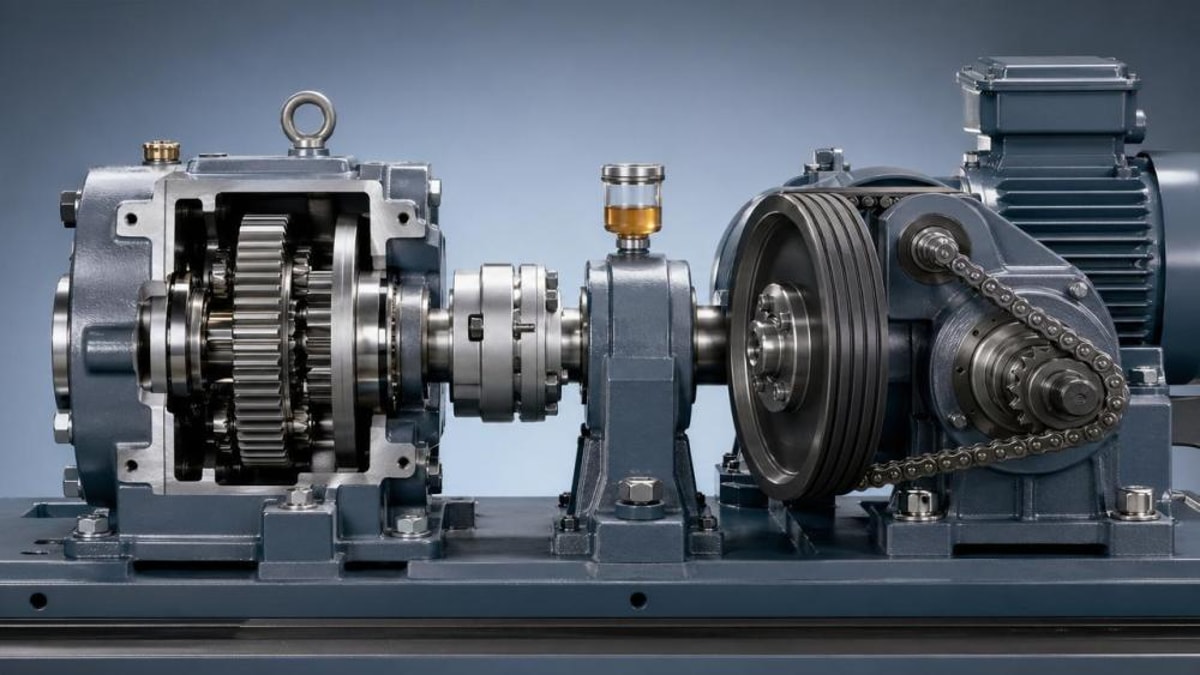
Many transmission components operate under constant stress, so it is easy to assume that shortened life is normal aging. In reality, gears, bearings, belts, chains, couplings, and shafts are designed to deliver predictable life when alignment, load, lubrication, mounting, and cleanliness are controlled. When a component fails early, the first question should not be “What wore out?” but “What operating condition accelerated the damage?”
This distinction matters because replacing parts without correcting the system only resets the failure clock. A new bearing installed on a misaligned shaft, a new chain fitted to worn sprockets, or a new belt tensioned by feel instead of specification may restore operation temporarily, but the same damage pattern will return. That is why after-sales maintenance must connect symptoms to transmission behavior rather than isolated component replacement.
Mechanical power transmission issues also tend to develop gradually. A small angular misalignment, slight lubricant contamination, modest overload from process changes, or minor soft-foot condition may not trigger immediate shutdown. Instead, the machine continues to run while efficiency drops and internal stress rises. By the time obvious noise, heat, or vibration appears, the service life of multiple parts may already be severely reduced.
Misalignment: one of the fastest ways to shorten transmission life
Misalignment is among the most common and costly causes of early failure in mechanical power transmission systems. It affects couplings, bearings, seals, belts, chains, and gears because it forces rotating elements to carry load unevenly. Even when equipment still runs, misalignment increases radial and axial forces, raises operating temperature, and generates vibration that spreads through the drive train.
For maintenance personnel, the challenge is that misalignment is not always dramatic. A machine may start, run, and produce output while showing only subtle signs such as repeated coupling insert wear, one-sided belt wear, leaking seals, hot bearing housings, or recurring looseness at mounting points. These are often treated as separate defects, but together they point to a geometry problem in the transmission path.
Correction requires more than quick visual adjustment. Reliable alignment depends on checking shaft position, base condition, pipe strain, thermal growth, soft foot, and coupling tolerances. In field service, one common mistake is aligning a machine in a cold state when operating temperature shifts the centerline during production. Another is overlooking frame distortion caused by uneven foundation support. If those factors remain, precision alignment at installation will not hold in service.
A useful practice is to compare failure locations across repeated service jobs. If the same bearing position overheats, the same side of a belt frays, or the same coupling element fails every cycle, the maintenance team should suspect alignment or structural distortion before blaming part quality. This pattern-based thinking often saves significant downtime and unnecessary replacement cost.
Lubrication problems: not just too little oil, but the wrong lubrication condition
Lubrication failure is another major reason service life collapses in transmission systems. However, poor lubrication does not simply mean low oil level or missed greasing. It also includes wrong viscosity, incompatible grease mixing, excessive grease volume, poor re-lubrication interval, degraded additives, water ingress, and particle contamination. Each of these changes the oil film or grease behavior that protects surfaces under load.
In gears and bearings, the goal of lubrication is to maintain a stable separating film between moving surfaces. When that film becomes too thin, metal contact increases, friction rises, and micro-pitting, scuffing, smearing, or spalling can begin. In chains, inadequate lubrication leads to pin and bushing wear, elongation, and stiff links. In belt drives, contamination from oil can degrade belt friction characteristics and accelerate slip and heat generation.
After-sales teams should avoid assuming that more lubricant is automatically safer. Over-greasing can be as harmful as under-greasing because it causes churning, heat build-up, seal stress, and oxidation. The correct lubrication condition must match speed, load, ambient temperature, duty cycle, and component design. A slow heavily loaded chain and a high-speed bearing do not require the same treatment, even if they are on the same machine.
To improve life, maintenance teams should document lubricant type, application amount, interval, contamination sources, and temperature trend. Oil analysis, grease condition checks, and particle control are not only for large critical assets. Even in general industrial applications, they provide early insight into whether a transmission is failing due to wear debris, moisture, viscosity loss, or thermal degradation long before catastrophic damage occurs.
Overload and shock load: hidden operating changes that destroy expected life
Many mechanical power transmission components are selected according to rated torque, speed, and duty assumptions. Service life becomes unreliable when the real operating profile changes after installation. Production increases, harder material feed, jam events, start-stop cycles, emergency reversals, and uncontrolled acceleration can all create overload or repeated shock loading that the original transmission was not prepared to absorb.
From a maintenance perspective, overload damage often appears as repeated tooth cracking, chain stretch, keyway fretting, coupling element rupture, shaft fatigue, or bearing distress. Yet the failed component may still be replaced with the same specification because no one has reviewed whether the process changed. This is a common gap between maintenance records and operating history. The machine seems to have a parts problem, but it actually has a duty-cycle problem.
Shock loads are especially destructive because they create short-duration peak forces much higher than average measured load. A drive may appear acceptable in normal running data while still suffering damaging torque spikes during startup, sudden stopping, or product blockage. Maintenance personnel should ask operators about jams, abrupt control changes, and abnormal starts. These field observations often reveal the reason components are not reaching their expected life.
Where overload is confirmed, the solution may involve torque limiters, softer starts, revised chain or belt selection, upgraded coupling design, gear ratio changes, or process control adjustments. Replacing failed parts without addressing shock events will not produce sustainable reliability. For after-sales service teams, this is where technical diagnosis creates real value beyond simple repair execution.
Contamination and sealing failures: the small entry points that lead to big losses
Contamination is one of the most underestimated mechanical power transmission issues because the particles or moisture entering the system are often small, gradual, and easy to miss. But once contaminants enter a bearing, gearbox, chain enclosure, or seal interface, they can disrupt lubricant film, abrade surfaces, corrode metal, and accelerate fatigue. The result is reduced efficiency and sharply shortened service life.
Dusty environments, washdown areas, metal fines, coolant mist, and poor storage practices all contribute to contamination risk. In after-sales maintenance, teams often focus on the damaged internal parts but overlook the path by which contamination entered. A worn seal lip, damaged breather, loose housing cover, missing guard, or poor lubricant handling method may be the true source of failure. Unless that path is corrected, the replacement component will be exposed to the same conditions immediately.
Chain drives are particularly vulnerable when they run unguarded or in dirty environments. Abrasive particles combine with lubricant to form a grinding paste, which accelerates pin and bushing wear. Gearboxes may suffer from moisture ingress that leads to emulsified oil and corrosion pitting. Belt drives can collect debris that affects tracking and tension consistency. Each case demonstrates that surface cleanliness around the drive is part of life extension, not just appearance.
Good contamination control starts with practical habits: sealed storage of lubricants, clean transfer tools, inspection of breathers and seals, routine cleaning around drive zones, and documented checks after washdown or process upset. For maintenance teams, these low-cost controls often deliver more life extension than frequent part replacement.
Tension, backlash, and fit errors that create constant stress
Improper adjustment is another frequent source of shortened life in mechanical power transmission assemblies. Belt drives with excessive tension overload bearings and shafts, while insufficient tension causes slip, heat, and rapid belt wear. Chains that are too tight lose articulation freedom and create unnecessary load; chains that are too loose produce impact, poor engagement, and accelerated sprocket wear. Similar issues exist in gears, where incorrect backlash or mounting distance changes contact patterns and surface stress.
Fit errors also matter. Bearings mounted with incorrect interference, shafts with damaged journals, keys fitted loosely, or hubs installed with poor surface preparation create movement where there should be stability, or stress where there should be controlled support. These conditions can generate fretting, uneven loading, heat, and premature fatigue. In many service cases, the component itself is blamed when the real issue is the way it was mounted.
After-sales maintenance should therefore treat installation quality as a reliability variable, not a final step. Measuring tension with appropriate tools, verifying gear contact patterns, checking shaft and bore tolerances, and confirming fastener tightening method all help prevent hidden stress. “Installed correctly” should mean documented against specification, not judged by experience alone.
When repeated failures occur shortly after service, reviewing installation practices is essential. If service life drops after each intervention rather than improving, the team should examine whether mounting technique, adjustment method, or tolerance control introduced new transmission problems during repair.
How maintenance teams can detect life-shortening issues earlier
Early detection depends on observing changes in condition before visible failure occurs. For most transmission systems, the useful indicators are not complicated: vibration trend, temperature rise, noise pattern, lubricant appearance, wear debris, alignment drift, tension loss, and load history. The key is to track them consistently enough to recognize deviation from normal operation rather than waiting for failure symptoms to become obvious.
Field inspections should include both static and running checks. Static checks may cover fastener condition, guarding, tension, lubrication level, leakage, seal condition, and alignment references. Running checks should look at temperature distribution, unusual sound, vibration behavior during load change, chain motion, belt tracking, and coupling movement. Maintenance teams that separate these two inspection modes usually find more root causes than teams relying on shutdown checks only.
One of the most effective habits is failure pattern documentation. Instead of recording only the replaced part, note the wear mode, location, operating hours, load context, lubricant condition, and surrounding symptoms. Over time, these details reveal whether the dominant issue is overload, contamination, misalignment, poor lubrication, or installation error. That insight supports better spare parts planning and more targeted corrective action.
For critical assets, condition monitoring tools such as vibration analysis, thermography, oil analysis, and laser alignment data provide stronger evidence. But even without advanced systems, disciplined inspections and clear records can dramatically improve diagnosis. The objective is not to collect more data for its own sake, but to catch transmission conditions that are consuming service life in the background.
Practical priorities for after-sales maintenance when failures keep repeating
When the same equipment returns with recurring transmission failures, maintenance teams should resist the pressure to focus only on speed of replacement. A better sequence is to verify load conditions, inspect alignment and base integrity, review lubrication practice, check contamination sources, confirm tension or backlash settings, and compare the wear pattern with previous failures. This structured approach usually exposes a system-level cause that simple replacement would miss.
It is also important to communicate clearly with operators and plant managers. If a transmission issue is linked to process overload, uncontrolled startup, poor cleaning practice, or changed duty cycle, the corrective action may require cooperation beyond the maintenance department. After-sales professionals create more value when they connect technical findings to operating behavior and explain the service-life consequence in practical terms.
Another priority is distinguishing between acceptable wear and abnormal wear. Every transmission component has a finite life, but abnormal wear leaves clues: asymmetric contact, discoloration from heat, lubricant breakdown, spalling concentrated in one zone, repeated seal failure, or deformation inconsistent with design load. Recognizing these signs helps teams avoid normalizing damage that is actually preventable.
Finally, repeated failure should trigger a review of component selection. If the machine has evolved beyond its original duty assumptions, an upgrade in material, sealing, lubrication method, or transmission design may be justified. Service life cannot be restored by maintenance technique alone if the installed system is no longer suitable for the application.
Conclusion: service life improves when teams fix the condition, not just the component
Mechanical power transmission problems that shorten service life are rarely random. In most cases, they trace back to a manageable condition: misalignment, incorrect lubrication, overload, contamination, poor adjustment, or installation error. The visible wear is only the final result of stress that has been building through the drive system for some time.
For after-sales maintenance personnel, the most effective mindset is to move beyond part replacement and focus on root-cause correction. When inspections, records, and corrective actions are organized around actual transmission behavior, repeat failures decline, equipment reliability improves, and service intervals become more predictable. That is the practical value of understanding mechanical power transmission at the system level.
In daily work, the biggest gains often come from simple but disciplined actions: verify alignment, control lubrication quality, monitor load changes, protect against contamination, and install components to specification. These steps may seem routine, but they directly determine whether a machine reaches its expected life or fails far too early. For maintenance teams responsible for uptime, that difference is where real performance is won.
Related News
- Choosing a Power Transmission Systems Manufacturer for Long-Term ReliabilityMay 05, 2026Power transmission systems manufacturer selection shapes uptime, cost, and resilience. Learn how to compare engineering, materials, and support for long-term reliability.
- Precision Powertrain Upgrades That Improve Torque StabilityMay 04, 2026Precision powertrain upgrades improve torque stability, reduce vibration, and extend component life. Discover how smarter design choices boost reliability and efficiency.
- Mechanical power transmission issues that shorten service lifeApr 30, 2026Mechanical power transmission failures often start with hidden misalignment, poor lubrication, overload, or contamination. Learn the warning signs and fixes that extend service life and reduce repeat breakdowns.
- Hidden sourcing risks in mechanical power transmission componentsApr 30, 2026Mechanical power transmission components sourcing can hide costly risks in quality, delivery, and compliance. Discover scenario-based procurement insights to reduce downtime and buy smarter.
Related News
- 00
0000-00
Industrial Automation Components Supplier: Key Compliance Checks Before Scaling Orders - 00
0000-00
How to Shortlist a Precision Engineering Supplier for Repeatable Quality - 00
0000-00
Evolutionary Trends in Precision Engineering: What Is Changing in Supplier Capabilities - 00
0000-00
When Precision Manufacturing OEM Makes Sense Over In-House Production - 00
0000-00
Hydraulic Valve Blocks for Precision Engineering: What Affects Service Life Most
Power Trans Designer
Strategic Intelligence Center