





Hidden maintenance costs often begin with overlooked mechanical components that quietly influence uptime, labor intensity, spare-part planning, and lifecycle budgets. For project managers and engineering leaders, understanding how bearings, chains, couplings, seals, and valve blocks affect reliability is essential to controlling total cost of ownership. This article examines where these costs originate and how smarter component decisions can reduce risk, downtime, and long-term operational expense.
Why project teams should use a checklist to assess hidden maintenance costs
Many maintenance overruns are not caused by one dramatic equipment failure. They emerge from small decisions around mechanical components: a bearing specified only by purchase price, a chain selected without contamination exposure in mind, a coupling installed without alignment tolerance review, or a seal chosen for nominal pressure but not thermal cycling. For project managers, these choices are rarely isolated technical details. They affect commissioning speed, service intervals, safety planning, contractor dependency, and shutdown frequency.
A checklist-based approach is valuable because hidden costs usually sit between departments. Engineering may focus on performance, procurement on lead time, maintenance on accessibility, and operations on uptime. Unless teams use shared decision criteria, mechanical components that look acceptable on paper can create recurring labor cost, unstable production, emergency stocking, and unplanned line stoppages.
In broad industrial settings, the most expensive component is not always the one with the highest invoice value. Frequently, the costliest item is the one that causes repeated lubrication tasks, premature wear, frequent alignment correction, seal leakage, or difficult replacement in a tight machine envelope. That is why project leaders should evaluate mechanical components through a lifecycle lens rather than a unit-cost lens.
- Check total intervention frequency, not just expected design life.
- Confirm whether maintenance can be performed safely and quickly in the actual installation space.
- Review how component failure affects adjacent systems such as motors, shafts, hydraulics, or guarding.
- Estimate the operational cost of contamination, misalignment, vibration, and improper lubrication.
Core checklist: the first mechanical components to review for hidden cost exposure
If a project team needs a fast method to prioritize risk, start with the components that combine motion, load transfer, sealing, and fluid control. These categories drive a large share of maintenance complexity across conveyors, pumps, mixers, packaging lines, mobile systems, and process equipment. The goal is not to inspect everything equally. The goal is to identify which mechanical components can multiply service hours and downtime when conditions drift away from ideal assumptions.
The following table can be used during design review, vendor comparison, retrofit evaluation, or pre-handover acceptance. It translates technical concerns into project-level maintenance questions, making it easier for engineering and management teams to align on risk.
This type of review is especially useful when project teams work across suppliers. A component may meet catalog performance yet still impose hidden cost if maintenance tools are proprietary, delivery time is long, or replacement requires major disassembly. Mechanical components should therefore be judged by maintainability and supply-chain resilience as much as by mechanical rating.
Priority checks before approval
Before approving final specifications, ask whether the component is truly matched to the duty cycle, contamination level, operator skill, and maintenance model of the site. These basic questions often reveal whether a low upfront price is likely to become a high ownership burden.
- Is the real operating environment harsher than the design note suggests?
- Can the component be inspected, lubricated, aligned, or replaced without extended shutdown?
- Are standard spare parts available regionally within the required response window?
- Will failure create secondary damage in nearby mechanical components?
- Does the supplier provide tolerancing, installation, and failure-analysis support?
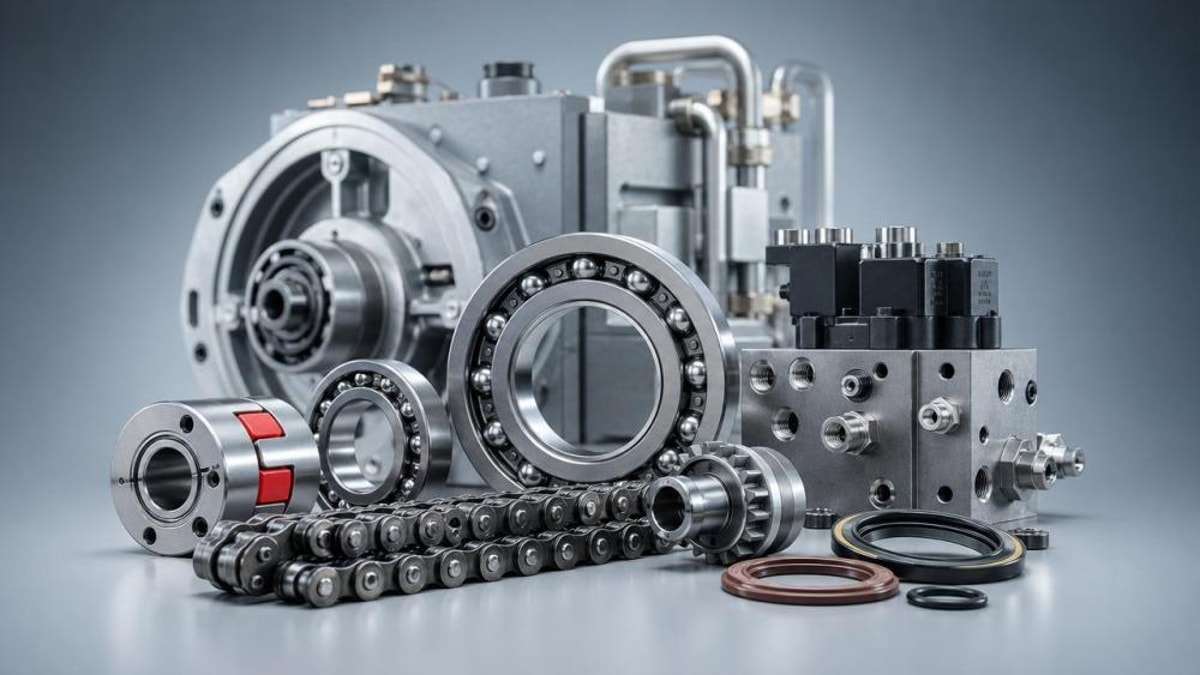
How to assess bearings, chains, couplings, seals, and valve blocks in practical terms
Project managers do not need to become component specialists, but they do need a clear framework for evaluating where maintenance cost enters the system. The most useful method is to examine each group of mechanical components by labor demand, failure mode visibility, replacement complexity, and effect on uptime.
When this practical lens is applied, components that were previously treated as standard line items become strategic reliability levers. A well-chosen bearing arrangement may eliminate recurring relubrication rounds. A better seal material can reduce leak-related cleaning and compliance exposure. An accessible coupling design can turn a multi-hour stop into a short service task.
The checklist below helps teams convert technical evaluation into maintenance planning logic.
Bearings: cost drivers beyond purchase price
Bearings are a common source of hidden maintenance costs because they fail from system-level issues as often as from material limits. Shaft finish, housing accuracy, lubricant condition, and contamination control often matter as much as dynamic load rating. If these basics are not managed, replacement frequency rises and neighboring parts degrade as well.
Checklist for bearing-related decisions
- Verify whether grease or oil strategy matches temperature, speed, and service interval expectations.
- Confirm sealing performance against dust, washdown, metal particles, or chemical exposure.
- Review installation method to avoid preload errors and fit damage during assembly.
Chains and couplings: hidden labor multipliers
Chains and couplings often create ongoing labor costs rather than sudden catastrophic loss. Chains may require frequent tension correction and lubrication. Couplings may run acceptably for months while transmitting misalignment that shortens motor, gearbox, and bearing life. These are classic examples of mechanical components whose hidden cost appears in maintenance hours, not just spare-part spend.
What to confirm during review
- Check whether alignment tolerances are realistic for the installation base and thermal growth pattern.
- Assess whether guards, access panels, and surrounding equipment allow routine service without major dismantling.
- Determine whether lubrication tasks can be standardized or automated to reduce operator variability.
Seals and hydraulic valve blocks: small parts, large consequences
Seals and valve blocks are frequently underestimated because they are compact relative to the systems they protect or control. Yet leakage, pressure instability, and contamination sensitivity can generate broad operational losses. Cleanup, troubleshooting time, fluid replacement, and safety response all add to the real cost profile of these mechanical components.
Review points that reduce long-term expense
- Match seal material to actual fluid chemistry, not just nominal media description.
- Specify filtration and cleanliness requirements for valve blocks early in the project.
- Require diagnostic clarity so field teams can isolate faults quickly instead of replacing parts by trial and error.
Common hidden-cost signals that project leaders often miss
Hidden maintenance costs usually appear as weak signals before they become budget problems. The challenge is that these signals are distributed across procurement notes, commissioning records, operator feedback, and maintenance logs. Project leaders who learn to spot them early can intervene before repeated service events become normalized.
One major warning sign is when component replacement is treated as routine despite no formal root-cause closure. Another is when maintenance tasks depend heavily on a few experienced technicians because procedures are too sensitive or component handling is not standardized. This usually means the chosen mechanical components are creating avoidable organizational risk in addition to technical risk.
A third warning sign is mismatch between expected and real maintenance cadence. If lubrication, alignment, seal inspection, or hydraulic troubleshooting occur more often than planned, ownership cost assumptions should be revised immediately rather than deferred to future budget cycles.
Risk reminders to include in project reviews
- A lower-cost component can become expensive if spare lead time forces excess inventory.
- Maintenance-free claims should be validated against actual load, contamination, and temperature conditions.
- Component compactness may improve design density while making inspection and replacement far harder.
- Frequent minor leaks and vibration events often consume more total cost than isolated major breakdowns.
Execution plan: how to reduce lifecycle cost through better component decisions
The most effective cost-control strategy is to move component evaluation earlier in the project cycle. Once installation layout, access routes, and supplier choices are fixed, the cost of improving maintainability rises sharply. For that reason, project teams should create a short but disciplined review process for critical mechanical components during design freeze, factory acceptance, and early operation.
This process should combine engineering evidence with operating reality. Instead of asking only whether the component can perform, ask whether it can perform consistently with the available maintenance resources, spare-part strategy, and uptime target. That question is more aligned with total cost of ownership and more useful for management decisions.
For organizations managing multiple sites or mixed equipment fleets, standardizing component evaluation criteria is especially powerful. It reduces specification drift, improves spare commonality, and strengthens supplier accountability across programs.
Recommended action checklist
- Create a ranked list of critical mechanical components by downtime impact and service frequency.
- Document real operating conditions, including contamination, thermal cycling, shock load, and cleaning method.
- Review maintainability: access, tooling, isolation steps, labor hours, and safety controls.
- Compare at least two component options using lifecycle cost, not only purchase price.
- Define spare strategy based on failure consequence, replacement time, and regional availability.
- Require supplier support for installation guidance, failure analysis, and performance documentation.
Information to prepare before supplier or internal review
If your team wants to refine component selection or maintenance strategy, prepare a concise package of decision inputs. Include operating profile, duty cycle, contamination risks, maintenance staffing model, expected uptime, current failure records, and target service interval. For bearings, chains, couplings, seals, and valve blocks, these details often determine whether a standard option is sufficient or whether a higher-grade design will save money over time.
For project managers and engineering leaders, the practical takeaway is clear: mechanical components should be evaluated as cost drivers, not just as bill-of-material entries. When teams use structured checks, ask the right supplier questions, and connect technical selection to field service reality, hidden maintenance costs become easier to predict and much easier to prevent.
If you need to move from general review to implementation, the next discussion should focus on application parameters, component interchangeability, installation constraints, expected maintenance intervals, spare-part availability, budget thresholds, and supplier response capability. Those are the questions that turn a component choice into a reliable long-term project decision.
Related News
- Precision Components for Power Transmission: Common Quality Risks to Check FirstMay 05, 2026Precision components for power transmission: discover the first quality risks to inspect, from material mismatch to tolerance drift, to reduce downtime and prevent costly failures.
- High-Precision Bearings: Key Differences That Affect Service LifeMay 04, 2026High-precision bearings affect service life more than appearance suggests. Learn how material, tolerance, lubrication, and load performance impact reliability and downtime.
- Mechanical components that drive hidden maintenance costsApr 30, 2026Mechanical components can quietly raise maintenance costs through downtime, labor, and spare-part risk. Learn where hidden expenses start and how smarter choices improve reliability.
- Why precision mechanical components fail earlier than expectedApr 30, 2026Precision mechanical components fail early for predictable reasons. Discover a practical checklist to spot lubrication, alignment, contamination, and load issues fast.
Related News
- 00
0000-00
Industrial Automation Components Supplier: Key Compliance Checks Before Scaling Orders - 00
0000-00
How to Shortlist a Precision Engineering Supplier for Repeatable Quality - 00
0000-00
Evolutionary Trends in Precision Engineering: What Is Changing in Supplier Capabilities - 00
0000-00
When Precision Manufacturing OEM Makes Sense Over In-House Production - 00
0000-00
Hydraulic Valve Blocks for Precision Engineering: What Affects Service Life Most
Tribology Specialist
Strategic Intelligence Center